Showing posts with label market. Show all posts
Showing posts with label market. Show all posts
Saturday, November 20, 2010
What to Look for when Picking Your Steer

Muscle in the forearm, rib, loin, hip,stifle quarter and a wide base. If your young steer does not show potential in these areas when you buy him there is a very good chance he won't have it when he is finished.
Structure correctness look at the feet, straightness of the legs, and nice straight flat back with spring to the rib.depth of body, uniformity of body depth and chest width.

Now that has been said; you must have a picture of what you are looking for in your head and go into the pen of 75 to 100 head or more of cattle and pick your steer.
The way I do this is to pick 12 to 15 head that fit my list and chose from those; this only takes me about two or three hours; my cattle producer is very good to me.
I think the most important thing to look for is a steer with as many great qualities as possible, and the most important of all is a great disposition because if you can't show them, and you can't touch them, you can't judge them.
So that perfect crazy steer that runs, jumps, puts his head in the air and paws the ground; you run don't walk away from him NO matter how perfect he may look; for he will most likely be crazy in the show ring.

One last thing the Producer knows their cattle so talk to them and always take in consideration everything that they have to say, you are show casing their cattle and their brand is on your steer for all the world to see.
Show your steer with pride and confidence and no matter what the out come you can leave the ring knowing you did your best.
I myself have not had a Grand Champion Steer YET; but I have made it back to the championship round every year.
I do my best and that's all I can do.
Good Luck

Friday, April 2, 2010
Why Meat Goats?
My interest in Meat Goats all started when I decided to learn about how to judge the different Market animals raised and sold at fair time as part of the 4-H market animal projects.
Then one day I started asking questions and found out that one of my Dad's friends Son is making a very good living hauling meat goats to market. So I ask myself why Meat Goats?
This what I found out:
Goat is the most highly consumed meat in the world; and more goat’s milk is consumed worldwide than cow’s milk. In the United States, meat goat production is increasing because of goats’ economic value as efficient converters of low-quality forages into quality meat, and milk, products . There are several reasons for goats’ growing popularity in this country. A large factor is the large number of ethnic groups, who have a preference for goat meat, milk, and cheese products.
Another factor is the determination of many Americans to be self-sufficient. Where resources are limited, a small herd of goats may be the only livestock that a small, part-time farmer can raise to achieve self-sufficiency.
As well as being one of the most widely consumed meats in the world, goat meat is also one of the healthiest meats available for consumption. Goat meat is naturally low in fat, saturated fat and cholesterol while containing a high quantity of protein and iron.
I myself have never eaten Goats meat but I found a few different sites that might be of interest to you.
I just found this so interesting that I thought I would share it with you.
For now I will stick with my Red and Black Angus.
Then one day I started asking questions and found out that one of my Dad's friends Son is making a very good living hauling meat goats to market. So I ask myself why Meat Goats?
This what I found out:
Goat is the most highly consumed meat in the world; and more goat’s milk is consumed worldwide than cow’s milk. In the United States, meat goat production is increasing because of goats’ economic value as efficient converters of low-quality forages into quality meat, and milk, products . There are several reasons for goats’ growing popularity in this country. A large factor is the large number of ethnic groups, who have a preference for goat meat, milk, and cheese products.
Another factor is the determination of many Americans to be self-sufficient. Where resources are limited, a small herd of goats may be the only livestock that a small, part-time farmer can raise to achieve self-sufficiency.
As well as being one of the most widely consumed meats in the world, goat meat is also one of the healthiest meats available for consumption. Goat meat is naturally low in fat, saturated fat and cholesterol while containing a high quantity of protein and iron.
I myself have never eaten Goats meat but I found a few different sites that might be of interest to you.
I just found this so interesting that I thought I would share it with you.
For now I will stick with my Red and Black Angus.
Tuesday, March 30, 2010
Beef Quality Assurance
If you have a market beef project these are must reads, just follow the links to read all the information about Beef Quality Assurance.
Beef Quality Assurance is a national program that provides guidelines for beef cattle production. The program raises consumer confidence through offering proper management techniques and a commitment to quality within every segment of the beef industry.
“BQA is a process of figuring out what could go wrong, planning to avoid it – then validating and documenting what you have done. BQA is just part of good business,” explains Dee Griffin, DVM, associate professor at the University of Nebraska
Youth BQA objective
Youth BQA assist youth in understanding their role as producers in the food supply chain and their responsibility to produce a safe food product while caring for animals is an ethical manner.
Beef Quality Assurance is a national program that provides guidelines for beef cattle production. The program raises consumer confidence through offering proper management techniques and a commitment to quality within every segment of the beef industry.
“BQA is a process of figuring out what could go wrong, planning to avoid it – then validating and documenting what you have done. BQA is just part of good business,” explains Dee Griffin, DVM, associate professor at the University of Nebraska
Youth BQA objective
Youth BQA assist youth in understanding their role as producers in the food supply chain and their responsibility to produce a safe food product while caring for animals is an ethical manner.
Friday, March 19, 2010
Selecting 4-H Market Livestock Project Animals
INTRODUCTION — SELECTING ANIMALS FOR A "SYSTEMS APPROACH" MARKET LIVESTOCK PROGRAM
The first concept that needs to be understood is that selecting animals for a Systems Approach program is not the same as selecting a "show" animal to be groomed, molded and manipulated to fit the current fad of the show ring. With the "Systems Approach", animals are selected which, with proper management, will meet the typical standards for efficiency, profitability, and usefulness to the production, feedlot and packing industry and at the same time exhibit a high degree of acceptance by the consumer.
The Systems Approach project evaluation is based on achievement of standards for selection, management and efficient production of meat that is desirable to packer and consumer. The project evaluation card uses four categories to evaluate member achievement and success. The Lean Yield section of the card indicates the degree of success in selecting and producing a lean product profitable to the packer and desired by consumers. The Conformation/Usefulness evaluation looks individually at muscling, trimness, growth and frame and structure and balance. These factors are representative of potential for achieving a desirable yield grade, a high degree of production efficiency, a high level of consumer satisfaction and a desirable degree of longevity. The gain and quality grade section evaluates both profitability and consumer desirability. The rate of gain section recognizes successful animal management in achieving a high level of efficiency and profitability. Gain is rated higher for higher quality animals where each pound of gain is more valuable.
The primary purpose for selecting animals is to obtain an animal that when properly fed and managed will represent the best in the industry. This means that industry standards must be identified prior to selection. The following standards represent industry goals achievable by most youth livestock program participants. Judges use the "Systems Approach" evaluation card to provide an evaluation of these standards. Animal selection is guided by the same standards that are used to evaluate accomplishment.
TABLE 1. Typical minimum standards for performance and quality.
BEEF
USDA yield grade 3.0 or less.
Live weight 1150 to 1300 lb.
Minimum 2.8 lb. ADG.
Conformation Score of 22 or >.
PIGS
USDA grade of No. 1.
Muscle score of 7 or higher.
Live weight 240 to 270 lb.
Minimum 1.85 lb. ADG.
Conformation Score of 22 or >.
LAMBS
USDA Choice Y.G. 2 or >.
Muscle score of 7 or higher.
Live weight 115 to 145 lb.
Minimum 0.75 lb. ADG.
Conformation Score of 22 or >.
just click the link below to read it all.
this is a place to learn about selecting 4-H market livestock animals
written by: Chad C. Gibson, Gene W. Gibson, Jeff Goodwin
The first concept that needs to be understood is that selecting animals for a Systems Approach program is not the same as selecting a "show" animal to be groomed, molded and manipulated to fit the current fad of the show ring. With the "Systems Approach", animals are selected which, with proper management, will meet the typical standards for efficiency, profitability, and usefulness to the production, feedlot and packing industry and at the same time exhibit a high degree of acceptance by the consumer.
The Systems Approach project evaluation is based on achievement of standards for selection, management and efficient production of meat that is desirable to packer and consumer. The project evaluation card uses four categories to evaluate member achievement and success. The Lean Yield section of the card indicates the degree of success in selecting and producing a lean product profitable to the packer and desired by consumers. The Conformation/Usefulness evaluation looks individually at muscling, trimness, growth and frame and structure and balance. These factors are representative of potential for achieving a desirable yield grade, a high degree of production efficiency, a high level of consumer satisfaction and a desirable degree of longevity. The gain and quality grade section evaluates both profitability and consumer desirability. The rate of gain section recognizes successful animal management in achieving a high level of efficiency and profitability. Gain is rated higher for higher quality animals where each pound of gain is more valuable.
The primary purpose for selecting animals is to obtain an animal that when properly fed and managed will represent the best in the industry. This means that industry standards must be identified prior to selection. The following standards represent industry goals achievable by most youth livestock program participants. Judges use the "Systems Approach" evaluation card to provide an evaluation of these standards. Animal selection is guided by the same standards that are used to evaluate accomplishment.
TABLE 1. Typical minimum standards for performance and quality.
BEEF
USDA yield grade 3.0 or less.
Live weight 1150 to 1300 lb.
Minimum 2.8 lb. ADG.
Conformation Score of 22 or >.
PIGS
USDA grade of No. 1.
Muscle score of 7 or higher.
Live weight 240 to 270 lb.
Minimum 1.85 lb. ADG.
Conformation Score of 22 or >.
LAMBS
USDA Choice Y.G. 2 or >.
Muscle score of 7 or higher.
Live weight 115 to 145 lb.
Minimum 0.75 lb. ADG.
Conformation Score of 22 or >.
just click the link below to read it all.
this is a place to learn about selecting 4-H market livestock animals
written by: Chad C. Gibson, Gene W. Gibson, Jeff Goodwin
Wednesday, March 17, 2010
Weigh In is almost here
Weigh In of my market steers is this weekend; I can't wait to see what my steers are weighing.
After weigh in I will take my before pictures and post them so that you can see my steers.
Check back this weekend and check it out.
Just a reminder to please sign my guest book.
After weigh in I will take my before pictures and post them so that you can see my steers.
Check back this weekend and check it out.
Just a reminder to please sign my guest book.
Wednesday, February 17, 2010
Breaking to Lead
We had snow and a very cold weather this year. I hope you all did your own feeding this Winter?
I did all the feeding and watering of my Steers, each time I did my chores I talked and rubbed on my steers so not to loose the work I did last Fall on breaking them to touch.
 Now it is time to break them to lead. Everyone has a different way to do this. First I touched, rubbed and fed my steers all winter, doing this made it easier for me to break my steers to lead.
First I did the pull and release; this is done by pulling on the lead rope for a few minutes. This puts pressure on the steers head, and nose, then release the pressure. Do this until the steer takes a step or two. Repeat this step until the steer gives to you.
 Next Place your hand on the lead rope closer to the steers head, and take a few steps. You are still using the pull and release and trying to get you steer to give to you.
This all takes time, I do this every morning and night at feeding time. I lead them to where I feed and tie them up while they eat. After they eat I lead them around for a while.
I have found that when breaking to lead a few steps at a time is a good start.
 Before you know it your steers are leading all around the pen for you. Try to remember to stay calm and just keep working with them. I try to have my steers broke to lead by Spring so that it gives me time to do the ground work for the show ring.. Something to always remember; Your steers are not pets, I never let my guard down when working with my steers. I work on the leading and show ring skills to the day I show and sale my steers. Then and only then do I think that my steers are broke to lead, touch, and show.
I did all the feeding and watering of my Steers, each time I did my chores I talked and rubbed on my steers so not to loose the work I did last Fall on breaking them to touch.

First I did the pull and release; this is done by pulling on the lead rope for a few minutes. This puts pressure on the steers head, and nose, then release the pressure. Do this until the steer takes a step or two. Repeat this step until the steer gives to you.

This all takes time, I do this every morning and night at feeding time. I lead them to where I feed and tie them up while they eat. After they eat I lead them around for a while.
I have found that when breaking to lead a few steps at a time is a good start.
 Before you know it your steers are leading all around the pen for you. Try to remember to stay calm and just keep working with them. I try to have my steers broke to lead by Spring so that it gives me time to do the ground work for the show ring.. Something to always remember; Your steers are not pets, I never let my guard down when working with my steers. I work on the leading and show ring skills to the day I show and sale my steers. Then and only then do I think that my steers are broke to lead, touch, and show.
 Set you goals and work to meet them.
Stay Calm and just keep working.
If you give it your best; that is the best you can do.
Saturday, January 2, 2010
Selection and Management of 4-H Market Lambs
I found this for Jessica and Hunter they are member of my 4-H club that raise Market Lambs.
this article just for you. Check It out It is good stuff.
This is a great must Read for the first year, or like me someone who know nothing about raising market lambs.
By Mike Neary Extension Sheep Specialist Purdue University To read the full article click this link
Choosing what breed or breeds you want to raise is an important decision. You need to keep in mind that every breed has strong points, as well as weak points. Therefore, match up breeds with your particular situation. commercial white-faced and black-faced can also be used for market lambs. Make sure you know something about the breed character and traits of whatever breed you are choosing. Contact your state or national breed association for information about breeds you are interested in.
When choosing a producer to buy lambs from some important points need to be considered. Primarily, is the breeder an honest, respected person that will truthfully answer questions and assist you should a problem arise? Good producers back their product and help 4-H participants with their questions and offer advice.
When selecting lambs, keep in mind the final objective; production of a lamb with a high quality, lean, muscular carcass that is practically and economically produced. Most lambs should be slaughtered in a weight range of 105 to 130 pounds. Ideally, lambs should be slaughtered when they have from .1 to .2 inches of external body fat. This fat thickness range ensures that carcass quality is adequate, with minimal amounts of excess fat trim. Therefore, the final weight achieved when lambs are finished will vary depending on breed, frame size and nutrition.
A common fault in selecting market lambs is to select lambs that are of an extreme in a particular trait. Single trait selection for any type of livestock can quickly lead to decreased usefulness when other traits are measured. Therefore, lambs should be selected that are "well rounded" or complete. these lambs would be above average in all respects, rather than exceptional in one trait and below average in all others.
What is a complete lamb? A complete lamb is one that is above average in muscling, of adequate frame size to have economical gains and finish at a market acceptable weight and is structurally correct.
When evaluating a young lamb to predict future muscle thickness, you need to keep in mind carcass economics. The highest priced cuts from a lamb come from the hindsaddle, or from the last rib back. Your lamb should show evidence of depth and width through the loin, fullness and length through the rump, with a full, muscular leg and stifle. Also, the forearm area of lambs and fullness behind the shoulders are good indicators of future muscle development. A lamb is born with all the muscle fibers it will ever have, feeding or exercising will not make a lamb into something it is not genetically capable of being.
Frame size in lambs is used to predict growth potential and to predict size (weight) when properly finished. Usually, lambs should be from average to large in frame size, for their breed, for economical gains. Very small and very large frame size lambs should be avoided, as they often finish at weights that are not market acceptable. Frame size is often thought of as just height, when actually it includes body length and body capacity. Frame size can be compared to a rectangular box, with height, length and total volume all making an equal contribution. Ideally, lambs should be long in the hindsaddle (loin and rump) region.
Structural correctness refers to several traits. Certainly, your lambs should have sound mouths, normal eyes, and be free of any abnormalities. Feet and leg placement should be square with normal width and straightness. Furthermore, lambs should have strong pasterns and no feet problems. Do not buy lambs that limp and if a producer has footrot problems in his flock, consider buying from someone else.
Balance or eye appeal is also desirable in your lambs. Eye appeal is a subjective measurement, but generally, lambs should be level in the top line, straight and square over the rump, and not have extreme coarseness through the shoulder, neck and brisket area.
When buying your lambs, make sure they are within a manageable weight range. They need to be at least two months old and heavy enough to attain their finished weight by fair time. Most lambs will gain from 0.5 to 0.75 pounds per day. However, do not make the mistake of buying lambs that are too heavy. Lambs that are held at maintenance too long get stale appearing. Ideally, your lambs should be within a weight range that will allow for normal growth to reach market weight by fair time.
this article just for you. Check It out It is good stuff.
This is a great must Read for the first year, or like me someone who know nothing about raising market lambs.
By Mike Neary Extension Sheep Specialist Purdue University To read the full article click this link
Choosing what breed or breeds you want to raise is an important decision. You need to keep in mind that every breed has strong points, as well as weak points. Therefore, match up breeds with your particular situation. commercial white-faced and black-faced can also be used for market lambs. Make sure you know something about the breed character and traits of whatever breed you are choosing. Contact your state or national breed association for information about breeds you are interested in.
When choosing a producer to buy lambs from some important points need to be considered. Primarily, is the breeder an honest, respected person that will truthfully answer questions and assist you should a problem arise? Good producers back their product and help 4-H participants with their questions and offer advice.
When selecting lambs, keep in mind the final objective; production of a lamb with a high quality, lean, muscular carcass that is practically and economically produced. Most lambs should be slaughtered in a weight range of 105 to 130 pounds. Ideally, lambs should be slaughtered when they have from .1 to .2 inches of external body fat. This fat thickness range ensures that carcass quality is adequate, with minimal amounts of excess fat trim. Therefore, the final weight achieved when lambs are finished will vary depending on breed, frame size and nutrition.
A common fault in selecting market lambs is to select lambs that are of an extreme in a particular trait. Single trait selection for any type of livestock can quickly lead to decreased usefulness when other traits are measured. Therefore, lambs should be selected that are "well rounded" or complete. these lambs would be above average in all respects, rather than exceptional in one trait and below average in all others.
What is a complete lamb? A complete lamb is one that is above average in muscling, of adequate frame size to have economical gains and finish at a market acceptable weight and is structurally correct.
When evaluating a young lamb to predict future muscle thickness, you need to keep in mind carcass economics. The highest priced cuts from a lamb come from the hindsaddle, or from the last rib back. Your lamb should show evidence of depth and width through the loin, fullness and length through the rump, with a full, muscular leg and stifle. Also, the forearm area of lambs and fullness behind the shoulders are good indicators of future muscle development. A lamb is born with all the muscle fibers it will ever have, feeding or exercising will not make a lamb into something it is not genetically capable of being.
Frame size in lambs is used to predict growth potential and to predict size (weight) when properly finished. Usually, lambs should be from average to large in frame size, for their breed, for economical gains. Very small and very large frame size lambs should be avoided, as they often finish at weights that are not market acceptable. Frame size is often thought of as just height, when actually it includes body length and body capacity. Frame size can be compared to a rectangular box, with height, length and total volume all making an equal contribution. Ideally, lambs should be long in the hindsaddle (loin and rump) region.
Structural correctness refers to several traits. Certainly, your lambs should have sound mouths, normal eyes, and be free of any abnormalities. Feet and leg placement should be square with normal width and straightness. Furthermore, lambs should have strong pasterns and no feet problems. Do not buy lambs that limp and if a producer has footrot problems in his flock, consider buying from someone else.
Balance or eye appeal is also desirable in your lambs. Eye appeal is a subjective measurement, but generally, lambs should be level in the top line, straight and square over the rump, and not have extreme coarseness through the shoulder, neck and brisket area.
When buying your lambs, make sure they are within a manageable weight range. They need to be at least two months old and heavy enough to attain their finished weight by fair time. Most lambs will gain from 0.5 to 0.75 pounds per day. However, do not make the mistake of buying lambs that are too heavy. Lambs that are held at maintenance too long get stale appearing. Ideally, your lambs should be within a weight range that will allow for normal growth to reach market weight by fair time.
Wednesday, November 18, 2009
Do Your own Ground Work with Your 4-H market Animal Project
The Most important thing to remember is there can be only one Champion Showmen and Animal.
 In three short years I went from a show ring nightmare to the top six in showmanship, when I stepped out of the ring I made the statement I won; Some thought I was nuts! That is because I had a personal goal to be in the top six. This is why it is very important to set goals that you can realize. Of course I set my sights on Champion; REACH FOR THE STAR’S, but I will take that personal best win every time.
Tips for Mom and Dad
Teach us, show us, train us; but once we step in the ring we are on our own. Please don’t try to give us orders and tell us what to do. The judge wants to see what we know? We can not hear the judge if you are giving us directions on what to do. Believe me we are trying our best!
Safety
Teach us what to do when our steers are behaving badly. Let us do the groundwork and gain the trust of our animal.
Show us how to keep our cool so that we don’t get to nerves in the ring. This takes time and a lot of practice Our steers are BIG and that is the scariest thing.
Train us on how to keep our selves and the others in the ring from getting hurt. Show us what to do in the worst case of badly behaving steers.
To you who are showing the steers, no matter how bad it gets in the ring. If the Judge ask if you would like to leave the ring SAY NO! If the judge wants you to leave He or She will not give you the choice to stay.
This is the time to show that you did work with your steers, and what you have learned.
Below is my story that happened my first year.
My first year with beef project; I had every 4-h showman’s nightmare.

So when show day came around I thought I was good to go. I wasn't!
 After a couple of times around the ring in showmanship the calf name John Wayne; stepped on the edge of my right boot and tripped me, then he pinned me down by my pants leg. The Judge then came over and helped me up at that point the judge ask me it I want give up and leave the ring? I said NO! A couple of hours later I had to go back in the ring with John Wayne he did a little better this time. Not really!
By the way John Wayne was the gentle one, Now it is time to show Clint Eastwood.
 Here it comes, Clint was the wild one a big pain in the neck. Clint didn’t stand still at all. First he kicked another showman's comb out of her pocket and then he came within an inch of kicking the judge. Thank Goodness no one got hurt, The judge tried to touch Clint but No luck he danced and danced around, even without being able to touch Clint the judge placed him 3rd in his weigh class.
Afterward I thanked the judge for not taking me out of the ring.
Now would you like to Know what I learned from this nightmare?
1 - Saler is not a breed for a beginner; I might try Saler again when I get more experience. One thing about Salers they are a GREAT Steak, good eating.

3 - Never give up; when you are asked if you want to leave the ring say NO.
4 - If you can’t touch them you can’t judge them.
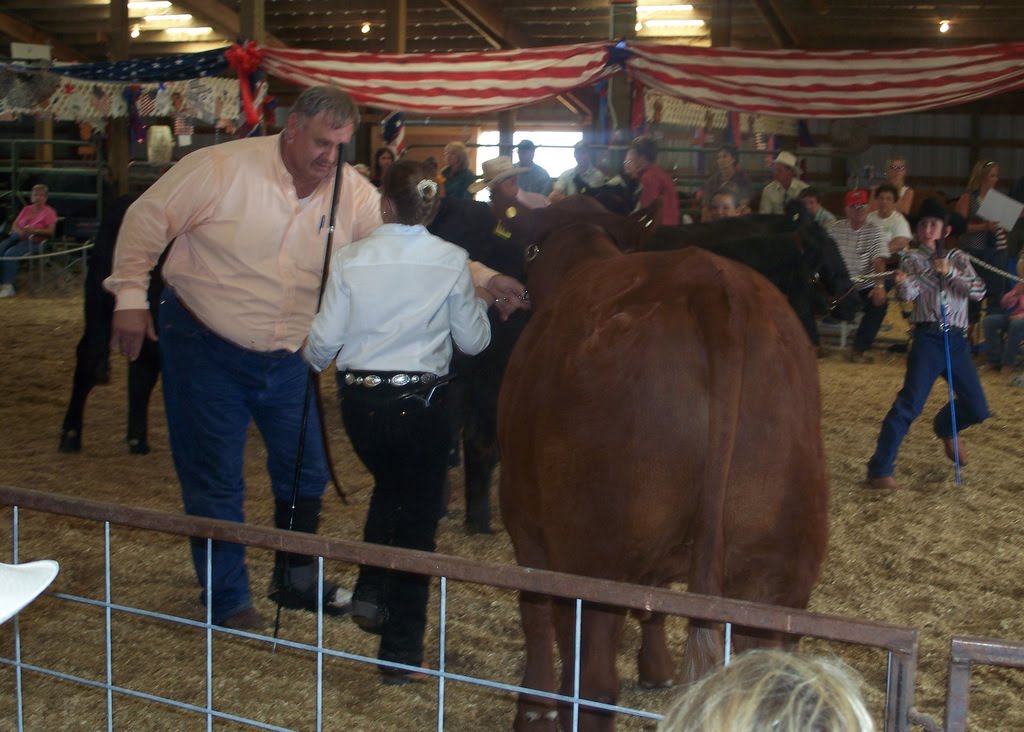
No matter where you are from it seems that there is one person at the fair that has a bad time with their animals, never count them out for that person just learned more than any other person there.
One last thing! Don't wait until the last minute to start working with you animals, these are not pets. Remember if you give it your best, that is the best you can do and just keep working at your show ring skills.

P.S.
This steers name was Clint Eastwood and the others steers name was John Wayne, Famous tough guys. I don't do that any more, because that is just what these two steers were tough guys.
Sunday, April 19, 2009
4-H meeting


Today was the fourth 4- h meeting of the Hodge Podgers.
The meeting was called to order. We welcomed Brandon to the club. Logan, Hunter, and I all suggested stuff we would like to learn. Logan wanted to learn about knitting, and leather. Hunter wanted to learn about lambs and cooking. I wanted to learn more about parts of the beef and where the parts are located on the steer. Nolan, Katelyn, and I did presentation. Nolan’s was on the ruminant system. Katelyn was on methane gas, and mine was on the eight important tips when making a quilt. Helen R. gave us the definition of motivation: Something, as a need to desire, which causes a person to act; causing or having the power to cause motion. Helen explained that no matter what she does or can say would do any good if we don’t have our own Motivation.
After that the meeting was adjourned. Dillon passed out cupcake that he made himself. As our after meeting snack. The cup cakes were really good.
Our next meeting will be doing our club community service project with a picnic afterwards.
Saturday, March 21, 2009
March 21, 2009 - Steer Weigh In


Today is the beginning of my 4-H Market Beef Project. This day started early we had to load my steers and take them to be weighted in and tagged. The week before weigh in I started giving my steers grain so that when weigh in was done my steers were ready to start the 149 days to the finished Market and the joy of showing my steers at the Fair.
Forest weighted - 745 pounds
Lt. Dan weighted - 765 pounds
Bubba weighted - 785 pounds
I have set there feeding schedule and I will talk, comb, practice and exercise them on a regular basis; this is the time for me and my steers to bond.
The weather here went from very cold to warn in just a few weeks, my steers are already loosing their winter coats soon they will be slick and shiny; their winter coats will come off even faster with daily brushing, combing, and bathing. I must tell you that having a steer project is not always just doing the fun stuff; you have to clean their pins, and watch to make sure that they stay healthy and if they get sick you will have to call the veterinarian.
Saturday, March 14, 2009
Fair Time 2008


After months of hard work; it is finely fair time and the fun part starts. You get to see if all your hard work pay off.
You need to keep a few things in mind: When going into the show ring the judge is not only looking at your steer He or She is also watching you. This is also the time when prospective buyer are watching and looking. You will want to look good; make sure you cloths are clean and pressed, and your hair is neat and clean. You what to look like a winner, the all American boy or girl showing the next Grand Champion.
Our First Meeting 2009
The meeting was called to order, pledges were said.
Old business - Hunter received his Clover Bud project awards.
New Business - All member renewed memberships, New Projects for 2009 were listed, and we talk about what we would like to do for Community Services project, and what we would like to learn this year.
All weight in Dates were given along with the dead line for each.
The meeting was adjourned and we all had a snack.
It was nice to see all my 4-H friends.
Old business - Hunter received his Clover Bud project awards.
New Business - All member renewed memberships, New Projects for 2009 were listed, and we talk about what we would like to do for Community Services project, and what we would like to learn this year.
All weight in Dates were given along with the dead line for each.
The meeting was adjourned and we all had a snack.
It was nice to see all my 4-H friends.
Friday, March 6, 2009
from start to finish 4-h market beef Project ( Red Angus ) 2008


To break a steer for Show takes a lot of time; you must be calm, and cool when working with them.
These are not pets, These Steers are raised as a of the 4-H market Beef Project. Along with showing them in the Show Ring. In the program you must keep health records, activity records, the 4-H member must do all the care, feeding and cleaning of the pen's themselves. This is a very demanding project.
from start to finish 4-h market beef Project ( Red Angus ) 2008


I am in 4-H; this is a picture of my steer project this is a baby steer he weights about 750 pounds. This is just one of many projects. This is Clover, I also has another steer Mikey, both steers are Red Angus.
Subscribe to:
Posts (Atom)