Life On The Farm As The Years Fly Bye

We All Learn At a Different Pace

What did I learn about myself through my 4-H participation?

I learned that it is not easy to be 16 and on the edge of adulthood.

Head - to clear thinking, when giving your word to someone, think about how it will affect your heart if you buckle to peer pressure and go against your morals and ethics .

Heart - to greater loyalty; loyalty is something that is given freely and cannot be demanded or forced upon someone.

Hands - to larger service, you can only do what you feel is right and work hard to achieve your goals.

Health - to better living; if your word is your honor, and you stand fast to your morals and ethics; loyalty will come to you freely, your goals will be realized, and you will make a difference in the world around you.


I love 4-H !


Peer pressure is one of the hardest things we face; stay true to yourself no matter how hard it is and make a difference!

4H My Journey

Farmer's Hands Video

2011-2012 Western National Roundup

Showing posts with label s. Show all posts

Saturday, August 14, 2010

Gooding County Style Revue 2010


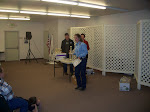
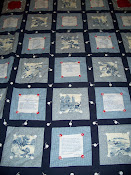
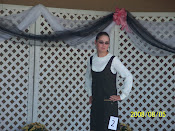
Here are a few pictures from my Day at the Gooding County Style Revue.


First you practice.


This is My Embellishment sewing project


This is my Vintage western shirt and Chinks. The Western Shirt is my sew Wow Sewing project, and the chinks is my leather project.


Our Fair has started and I will post the events when I can.

Thursday, July 29, 2010

My First 4-H Horse Show


I went to my first 4-H horse show; I think that I did very well,


I took my grandmothers horse Flash; he is just 4 years old. Flash and I are both novice in the horse-showing ring and placed first the intermediate age group.


.


My cousin Hannah also went and took her horse Custer; This is Hannah’s first year in
4-H and she also did very well. Hannah and Custer placed 3rd in the junior novice class.


The Moon Creek Ponies 4-H club also did a great job the Club took 4 out of 5 first place ribbons Plus The Grand Champion and the Reserve Champion. 

Congratulation
 Jessica - The Grand Champion
 Jacee - Reserve Champion


Saturday, January 2, 2010

Selection and Management of 4-H Market Lambs

I found this for Jessica and Hunter they are member of my 4-H club that raise Market Lambs.
this article just for you. Check It out It is good stuff.


This is a great must Read for the first year, or like me someone who know nothing about raising market lambs.


By Mike Neary Extension Sheep Specialist Purdue University      To read the full article click this link 


Choosing what breed or breeds you want to raise is an important decision. You need to keep in mind that every breed has strong points, as well as weak points. Therefore, match up breeds with your particular situation. commercial white-faced and black-faced can also be used for market lambs. Make sure you know something about the breed character and traits of whatever breed you are choosing. Contact your state or national breed association for information about breeds you are interested in.
When choosing a producer to buy lambs from some important points need to be considered. Primarily, is the breeder an honest, respected person that will truthfully answer questions and assist you should a problem arise? Good producers back their product and help 4-H participants with their questions and offer advice.
When selecting lambs, keep in mind the final objective; production of a lamb with a high quality, lean, muscular carcass that is practically and economically produced. Most lambs should be slaughtered in a weight range of 105 to 130 pounds. Ideally, lambs should be slaughtered when they have from .1 to .2 inches of external body fat. This fat thickness range ensures that carcass quality is adequate, with minimal amounts of excess fat trim. Therefore, the final weight achieved when lambs are finished will vary depending on breed, frame size and nutrition.
A common fault in selecting market lambs is to select lambs that are of an extreme in a particular trait. Single trait selection for any type of livestock can quickly lead to decreased usefulness when other traits are measured. Therefore, lambs should be selected that are "well rounded" or complete. these lambs would be above average in all respects, rather than exceptional in one trait and below average in all others.
What is a complete lamb? A complete lamb is one that is above average in muscling, of adequate frame size to have economical gains and finish at a market acceptable weight and is structurally correct.
When evaluating a young lamb to predict future muscle thickness, you need to keep in mind carcass economics. The highest priced cuts from a lamb come from the hindsaddle, or from the last rib back. Your lamb should show evidence of depth and width through the loin, fullness and length through the rump, with a full, muscular leg and stifle. Also, the forearm area of lambs and fullness behind the shoulders are good indicators of future muscle development. A lamb is born with all the muscle fibers it will ever have, feeding or exercising will not make a lamb into something it is not genetically capable of being.
Frame size in lambs is used to predict growth potential and to predict size (weight) when properly finished. Usually, lambs should be from average to large in frame size, for their breed, for economical gains. Very small and very large frame size lambs should be avoided, as they often finish at weights that are not market acceptable. Frame size is often thought of as just height, when actually it includes body length and body capacity. Frame size can be compared to a rectangular box, with height, length and total volume all making an equal contribution. Ideally, lambs should be long in the hindsaddle (loin and rump) region.
Structural correctness refers to several traits. Certainly, your lambs should have sound mouths, normal eyes, and be free of any abnormalities. Feet and leg placement should be square with normal width and straightness. Furthermore, lambs should have strong pasterns and no feet problems. Do not buy lambs that limp and if a producer has footrot problems in his flock, consider buying from someone else.
Balance or eye appeal is also desirable in your lambs. Eye appeal is a subjective measurement, but generally, lambs should be level in the top line, straight and square over the rump, and not have extreme coarseness through the shoulder, neck and brisket area.
When buying your lambs, make sure they are within a manageable weight range. They need to be at least two months old and heavy enough to attain their finished weight by fair time. Most lambs will gain from 0.5 to 0.75 pounds per day. However, do not make the mistake of buying lambs that are too heavy. Lambs that are held at maintenance too long get stale appearing. Ideally, your lambs should be within a weight range that will allow for normal growth to reach market weight by fair time.