Showing posts with label steers. Show all posts
Showing posts with label steers. Show all posts
Thursday, June 2, 2011
Life In The Show Ring!
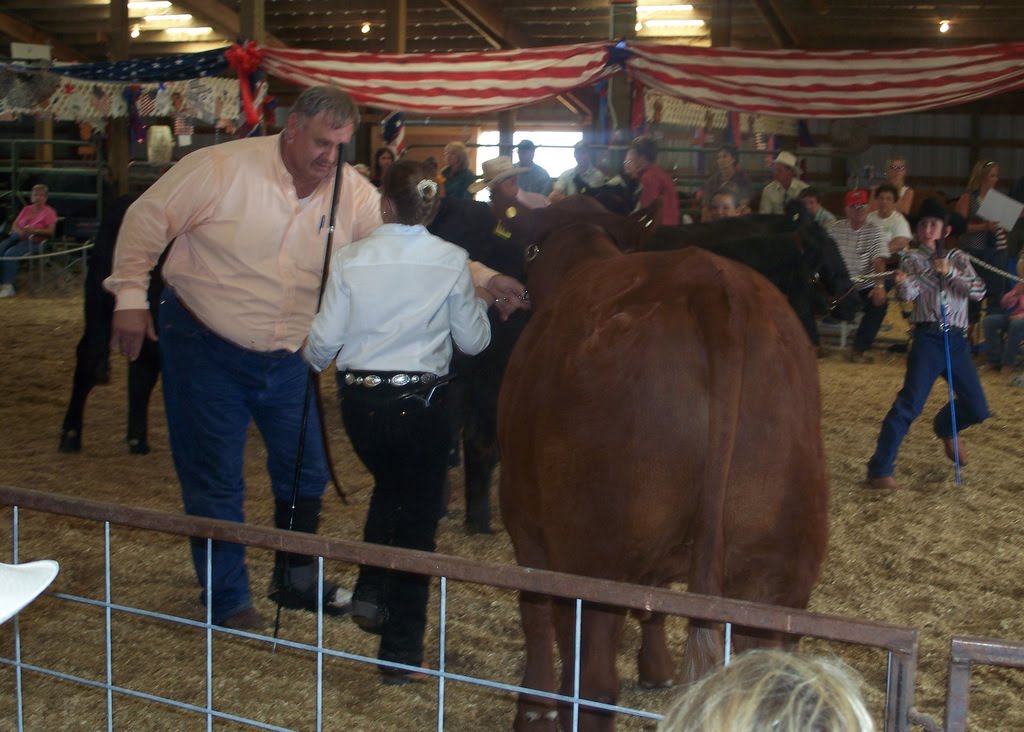
On May 28th I enter my steer Fabio and my heifer Lady in the Magic Valley Jr. Classic.
When I go to these shows, I have hopes of winning I guess we all what to win; but I also go for the learning experience. This year the quality of showmanship was out standing, the fitting and groomers were great, and all the cattle were fluff and fabulous.
To those who won Congratulation! You all did an outstanding job.
I knew from the time that Fabio stepped out to the trailer that I was at the Classic for the learning experience; his eyes got big and his head went up.
I had worked with him and all my other steers everyday and in the pen they all behaved great; Fabio does not have a mean bone in is body, but he is a little set in his ways and nerves. It was the noise, the strange environment, and people, that affected him, he just did not what to be there. I even thought about not showing him, but thanks to Mr. Hooper; Fabio did enter the show ring, he did not setup and behaved badly. Fabio and I lived through it.
The lesson that Fabio learned was that no matter how he acts he would be shown; the lesson I learned is that I can handle my steers even when they act like spoiled fit throwing brats; (you must call your steers bluff).
Mr. Hooper gave me a tip on how to correct Fabio’s behavior, and with his knowledge and experience with show cattle; I know that I will be able to take the brat out of Fabio. I am going to give it my best effort and we will see what happens at the next show. I am also going to use this tip on all my steers just to be on the safe side.
Check back and I will let you know how it goes and fill you in on the tip after a few weeks.
Fabio has never acted as he did at the Classic; so no matter how calm and well behaved your steers act at home does not mean that they will be that way in a strange environment.
Take your steers to a show or two for the learning experience. Maybe you will even come home with a ribbon or two.
As for Lady; I did not place but she was very well behaved.

Tuesday, March 29, 2011
Meet my 2011 Steers
Well it is still raining here and it seems that the mud just keeps getting deeper. Just the other day we had wind, rain, snow, freezing rain and by the end of the day we had blue sky's and sunshine. Maybe that is the first sign of spring.
Weigh-in for my county has come and gone so here is a look at my 2011 Market Beef Project .
My steer for 2011 are all different weights and frame styles this year; I am hoping that they don't all fall into the same weight class when our Fair rolls around.


 As you can see all three are a little muddy; but they are healthy, happy, and they love to eat.
When the rain stops my steers will get their first bath, I am hoping it will be this weekend. So for now I just wait.
Just a reminder; with wet cold and changing weather that in a blink of an eye your animals can get sick so keep a close eye on them and watch for illness.
Weigh-in for my county has come and gone so here is a look at my 2011 Market Beef Project .
My steer for 2011 are all different weights and frame styles this year; I am hoping that they don't all fall into the same weight class when our Fair rolls around.


When the rain stops my steers will get their first bath, I am hoping it will be this weekend. So for now I just wait.
Just a reminder; with wet cold and changing weather that in a blink of an eye your animals can get sick so keep a close eye on them and watch for illness.
Sunday, November 28, 2010
Snow, Snow, and more Snow!

I still have to go out and feed and water my steers and horses; boy it is cold! I still work with my steers at least twice a week no matter what. This is not the fun part of having 4-H steers but it is part of life if you want to be a cattle producer some day.

I was told that "grand champions are made over the Thanksgiving and Christmas breaks".
REMEMBER "you got to want it to win it"
I had to dig out the water troth.


This could be a long Winter if I have to dig every day!
Here is hoping that the snow melts a little.
Saturday, November 20, 2010
What to Look for when Picking Your Steer

Muscle in the forearm, rib, loin, hip,stifle quarter and a wide base. If your young steer does not show potential in these areas when you buy him there is a very good chance he won't have it when he is finished.
Structure correctness look at the feet, straightness of the legs, and nice straight flat back with spring to the rib.depth of body, uniformity of body depth and chest width.

Now that has been said; you must have a picture of what you are looking for in your head and go into the pen of 75 to 100 head or more of cattle and pick your steer.
The way I do this is to pick 12 to 15 head that fit my list and chose from those; this only takes me about two or three hours; my cattle producer is very good to me.
I think the most important thing to look for is a steer with as many great qualities as possible, and the most important of all is a great disposition because if you can't show them, and you can't touch them, you can't judge them.
So that perfect crazy steer that runs, jumps, puts his head in the air and paws the ground; you run don't walk away from him NO matter how perfect he may look; for he will most likely be crazy in the show ring.

One last thing the Producer knows their cattle so talk to them and always take in consideration everything that they have to say, you are show casing their cattle and their brand is on your steer for all the world to see.
Show your steer with pride and confidence and no matter what the out come you can leave the ring knowing you did your best.
I myself have not had a Grand Champion Steer YET; but I have made it back to the championship round every year.
I do my best and that's all I can do.
Good Luck
Thursday, September 16, 2010
Grading My Market Project Steers ( know what you are eating )
Today I went to the Bates Custom Butchers and graded my two remaining 4-H steers.

 Cindy Kinder the Extension Educator for Gooding County was my teacher.
To grade my beef we measured the size of the rib eye, back fat, and figure the kph fat, and you must have the carcass weight.
These two beef graded prime minus and choice plus. my third beef graded prime plus.
Grades are based on the amount of marbling in the meat and the age of the animal. Marbling is the flecks and streaks of white fat you find distributed throughout the meat. In general, the higher the degree of marbling, the more tender, juicy, and flavorable the meat will be. Higher grade meats come at a higher cost.
Beef is best in flavor and texture when cattle are between 18 and 24 months old, so the grading favors younger animals.
Meat graders assign a yield grade to a carcass by evaluating:
There are eight distinct grades of beef recognized by the USDA.


Just over half of the beef graded each your earns a grade of Choice.

USDA. In order of descending quality they are:
http://meat.tamu.edu/beefgrading.html
http://www.bbqreport.com/archives/barbecue/2006/03/02/understanding-the-usda-beef-grading-system/
and from
Cindy Kinder Extension Educator for Gooding County
for more information click the links above.
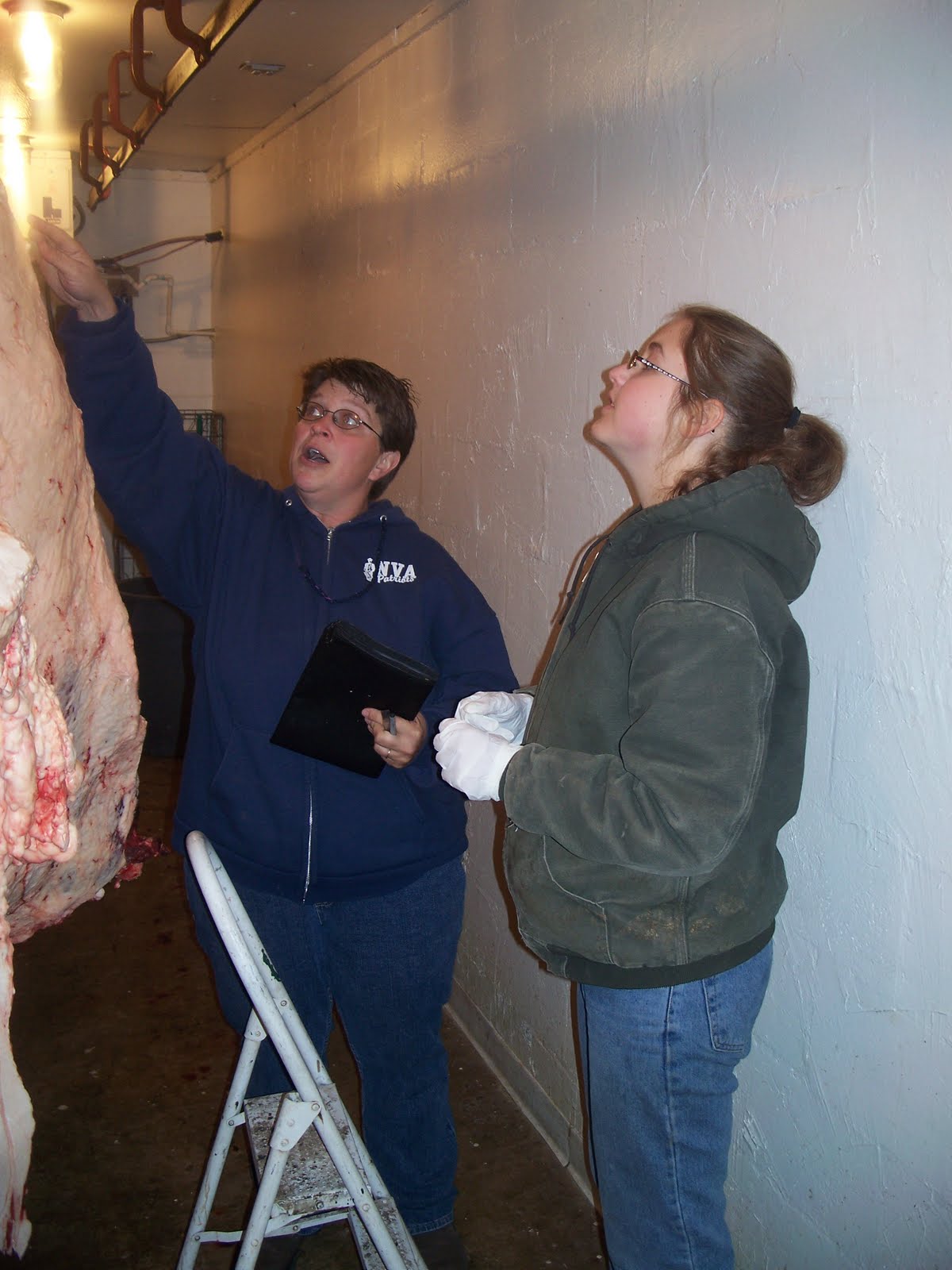
 Cindy Kinder the Extension Educator for Gooding County was my teacher.
To grade my beef we measured the size of the rib eye, back fat, and figure the kph fat, and you must have the carcass weight.
These two beef graded prime minus and choice plus. my third beef graded prime plus.
Grades are based on the amount of marbling in the meat and the age of the animal. Marbling is the flecks and streaks of white fat you find distributed throughout the meat. In general, the higher the degree of marbling, the more tender, juicy, and flavorable the meat will be. Higher grade meats come at a higher cost.
Beef is best in flavor and texture when cattle are between 18 and 24 months old, so the grading favors younger animals.
Meat graders assign a yield grade to a carcass by evaluating:
- the amount of external fat;
- the hot carcass weight;
- the amount of kidney, pelvic, and heart fat; and
- the area of the ribeye muscle.
There are eight distinct grades of beef recognized by the USDA.

USDA Prime Beef
- is the ultimate in tenderness, juiciness, and flavor.

USDA Choice Beef
Choice grade beef has less marbling than Prime, but is still of very high quality. This is the most popular grade of beef because it contains sufficient marbling for taste.Just over half of the beef graded each your earns a grade of Choice.

USDA Select beef
This is generally a lower priced grade of beef with less marbling than Choice. Select cuts of beef may vary in tenderness and juiciness.USDA. In order of descending quality they are:
- Prime
- Choice
- Select
- Standard
- Commercial
- Utility
- Cutter
- Canner
http://meat.tamu.edu/beefgrading.html
http://www.bbqreport.com/archives/barbecue/2006/03/02/understanding-the-usda-beef-grading-system/
and from
Cindy Kinder Extension Educator for Gooding County
for more information click the links above.
Monday, September 6, 2010
Clipping Your Steers for Begainners
By No means am I a steer clipping expert; but when I started learning to clip and groom my steers I could not find a place to show me just the basics. So this year one of my goals was to learn to clip and fluff my steers for the show ring and I thought I might share what I learned with you.
This year I had three steers so when my Dad was showing me what he knew my Mom was taking pictures for me to share.
 The most important thing you can do long before you start clipping is to wash and blow-dry your steer. Make sure that you comb and blow the hair forward.
 Next you will what to apply a styling mousse for steers, and comb it in I use a rice brush to do this. This foam creates a thicker hair coat without matting the hair. Great for training the hair, show day grooming or clipping. Now let the mousse dry.
 Clipping the the head, I was told to clip the hair in the direction that the hair lays. Try to not to clip to short; When I did my first head I clipped it to short; if this happens don't worry just spray pink oil on and it won't look so bad. I found that you should clip the head at least six or seven days before the show ( just in case ).
Depending on the style you can leave the hair on the pole of you can remove it. I did both ways this year .
You may want to leave the hair on the pole until you are at the show to see what the style is at that time.
 The Brisket is next; when clipping the brisket you clip from the head and neck downward. try not to take off all the hair you what this to be clipped but look natural.
 For the hoofs we clip the hair that lays on the hoof to clean them up a little. DO NOT Clip the hair on the legs.

Now that you have just the beginners basics go to the watch and learn and watch the pro's clip and groom.
 Red Angus do not have much hair in the summer so there is not much clipping to do; here is Munch he was my highest placing steer and graded prime plus.
 this is Pepper my Black Angus.
Remember you are trying to make your steers look the best that you can.
You will always what to follow the rules of the Show, Fair or Association that you are participating in.
This year I had three steers so when my Dad was showing me what he knew my Mom was taking pictures for me to share.


Depending on the style you can leave the hair on the pole of you can remove it. I did both ways this year .
You may want to leave the hair on the pole until you are at the show to see what the style is at that time.


Now that you have just the beginners basics go to the watch and learn and watch the pro's clip and groom.


Remember you are trying to make your steers look the best that you can.
You will always what to follow the rules of the Show, Fair or Association that you are participating in.
Friday, August 6, 2010
Thank You 2009 Buyer Farmers National Bank

This year seemed to have wings and just flew-by and it time for the
2010 GOODING COUNTY FAIR August 16th-21st.
At this time I would like to THANK my 2009 Buyer once again; with out your support I would not be able to continue my education in the Beef Industry.
Thank you so Much Farmer National Bank of Wendel Idaho.
Also Thanks to all of you who add-on and to my family.
Tuesday, June 8, 2010
The Magic Valley Jr. Beef Classic


It was a long day, my steer handled great. At the end of the day two of my steers received two second place ribbons and one third place ribbon in quality.
I think I did OK for my first time.
During your 4-H life-time; if you start showing when you are 8 years old you will only be in the show ring 10 times. If each time you enter the show ring, and you are there for 30 minutes you will have only showed for a total of about 300 minutes or 12.5 hours. Over 10 years that is not much time to perfect your showmanship skills. With each time you enter the ring the Judge will give you pointers to how to improve your skills and every Judge is different. My goal is to be grand champion showman and to have a grand champion steer. When you go to different shows you add a year of experience, receive lots of insight how to improve your skill and learn the grooming skills need to enhance the appearance of you steers
.
To have a 4-H Grand Champion Steer or Heifer it is very important to have the showmanship skills to show your steer or heifer at their best.
Wednesday, April 28, 2010
You , Your Steer, and the Grooming Chute
The weather here has had its good and bad day's. I hope you have had your steers on a regular feeding schedule, and that your steer is on full feed now and should be gaining at least 3 pounds a day. Your steer should now be touchable and leading should become easier each day hopefully you have been using the show stick each day (rain or shine); Because the real fun is about to begin.
The first thing I would like you to do is make sure your fitting chute is tied down. I know first hand the wreck you can have if it is not and you steer freaks out and takes off with it; your steer can become injured, and at the very least all the hard work you have done will be lost.
Now the fun part; you need to get your steer in the chute; if you have done all the ground work listed above it won't be to hard. If your steer is still a little hard to lead take your time, and add a safety rope tied to something I tie mine safety rope to the post that right next to the chute. Next take the lead rope and run it through the chute and hopefully they walk right in. If your steer does not walk in use the safety rope to get them back up to the chute and start again. Just keep working and talking to them and they will go in.

Once you have them in the chute for the first time you will want to tie their head up and just comb them; I do this with each of my steers; I want my steers to like the chute.
each one of my steers had their moment in the chute I like them to be in the chute for at least 30 minutes the first time.
 I comb them talk to them and just let them know that everything is OK.
In a day or two I will but my steers back in the chute and use the blower and turn on a pair of clipper and before you know it your steers are loving the time in the chute.
This is what works for me; when working with cattle sometimes you just play it by ear and go with what works.
 Check out the Watch and Learn Youtubes for more info on clipping and other tips.
The first thing I would like you to do is make sure your fitting chute is tied down. I know first hand the wreck you can have if it is not and you steer freaks out and takes off with it; your steer can become injured, and at the very least all the hard work you have done will be lost.
Now the fun part; you need to get your steer in the chute; if you have done all the ground work listed above it won't be to hard. If your steer is still a little hard to lead take your time, and add a safety rope tied to something I tie mine safety rope to the post that right next to the chute. Next take the lead rope and run it through the chute and hopefully they walk right in. If your steer does not walk in use the safety rope to get them back up to the chute and start again. Just keep working and talking to them and they will go in.

Once you have them in the chute for the first time you will want to tie their head up and just comb them; I do this with each of my steers; I want my steers to like the chute.
each one of my steers had their moment in the chute I like them to be in the chute for at least 30 minutes the first time.

In a day or two I will but my steers back in the chute and use the blower and turn on a pair of clipper and before you know it your steers are loving the time in the chute.
This is what works for me; when working with cattle sometimes you just play it by ear and go with what works.

Sunday, April 11, 2010
The Show Stick
Now is the time for your steers to meet the show stick. The way that I do this is while I have them tied up and they are eating. I let them see the stick, and smell the stick. I rub their brisket first and them their belly and last I just touch their feet. Start slow and for a short time Just a few minutes; then let them finish eating. Later in the afternoon I go back out and lead them around and use the stick a little more and try to set them up, now just do this each time you work with your calves.
Your goal is to stay calm, keep your cool, and just keep working with your calves and before you know it the touching, leading and setting up will all come together. You are trying to form a bond, gain you steer trust and built your own confidence.
When this all happens you and your steer will become a team.
I know that everyone has there own way to do this. This is just what works for me.
Your goal is to stay calm, keep your cool, and just keep working with your calves and before you know it the touching, leading and setting up will all come together. You are trying to form a bond, gain you steer trust and built your own confidence.
When this all happens you and your steer will become a team.
I know that everyone has there own way to do this. This is just what works for me.
Saturday, March 20, 2010
My 2010 4-H Steers


This is Pepper he weighed in at 878 pounds.
Black Angus

And this is George he weighed in at 868 pounds. Red Angus
All my steers lead and behaved very well the weigh-in process went very smooth; but they were glad to get home.
Now it is time to set the feeding, exercise, and training schedules.
Let the fun begin!!
Wednesday, March 17, 2010
Weigh In is almost here
Weigh In of my market steers is this weekend; I can't wait to see what my steers are weighing.
After weigh in I will take my before pictures and post them so that you can see my steers.
Check back this weekend and check it out.
Just a reminder to please sign my guest book.
After weigh in I will take my before pictures and post them so that you can see my steers.
Check back this weekend and check it out.
Just a reminder to please sign my guest book.
Wednesday, February 17, 2010
Breaking to Lead
We had snow and a very cold weather this year. I hope you all did your own feeding this Winter?
I did all the feeding and watering of my Steers, each time I did my chores I talked and rubbed on my steers so not to loose the work I did last Fall on breaking them to touch.
 Now it is time to break them to lead. Everyone has a different way to do this. First I touched, rubbed and fed my steers all winter, doing this made it easier for me to break my steers to lead.
First I did the pull and release; this is done by pulling on the lead rope for a few minutes. This puts pressure on the steers head, and nose, then release the pressure. Do this until the steer takes a step or two. Repeat this step until the steer gives to you.
 Next Place your hand on the lead rope closer to the steers head, and take a few steps. You are still using the pull and release and trying to get you steer to give to you.
This all takes time, I do this every morning and night at feeding time. I lead them to where I feed and tie them up while they eat. After they eat I lead them around for a while.
I have found that when breaking to lead a few steps at a time is a good start.
 Before you know it your steers are leading all around the pen for you. Try to remember to stay calm and just keep working with them. I try to have my steers broke to lead by Spring so that it gives me time to do the ground work for the show ring.. Something to always remember; Your steers are not pets, I never let my guard down when working with my steers. I work on the leading and show ring skills to the day I show and sale my steers. Then and only then do I think that my steers are broke to lead, touch, and show.
I did all the feeding and watering of my Steers, each time I did my chores I talked and rubbed on my steers so not to loose the work I did last Fall on breaking them to touch.

First I did the pull and release; this is done by pulling on the lead rope for a few minutes. This puts pressure on the steers head, and nose, then release the pressure. Do this until the steer takes a step or two. Repeat this step until the steer gives to you.

This all takes time, I do this every morning and night at feeding time. I lead them to where I feed and tie them up while they eat. After they eat I lead them around for a while.
I have found that when breaking to lead a few steps at a time is a good start.
 Before you know it your steers are leading all around the pen for you. Try to remember to stay calm and just keep working with them. I try to have my steers broke to lead by Spring so that it gives me time to do the ground work for the show ring.. Something to always remember; Your steers are not pets, I never let my guard down when working with my steers. I work on the leading and show ring skills to the day I show and sale my steers. Then and only then do I think that my steers are broke to lead, touch, and show.
 Set you goals and work to meet them.
Stay Calm and just keep working.
If you give it your best; that is the best you can do.
Wednesday, November 18, 2009
Do Your own Ground Work with Your 4-H market Animal Project
The Most important thing to remember is there can be only one Champion Showmen and Animal.
 In three short years I went from a show ring nightmare to the top six in showmanship, when I stepped out of the ring I made the statement I won; Some thought I was nuts! That is because I had a personal goal to be in the top six. This is why it is very important to set goals that you can realize. Of course I set my sights on Champion; REACH FOR THE STAR’S, but I will take that personal best win every time.
Tips for Mom and Dad
Teach us, show us, train us; but once we step in the ring we are on our own. Please don’t try to give us orders and tell us what to do. The judge wants to see what we know? We can not hear the judge if you are giving us directions on what to do. Believe me we are trying our best!
Safety
Teach us what to do when our steers are behaving badly. Let us do the groundwork and gain the trust of our animal.
Show us how to keep our cool so that we don’t get to nerves in the ring. This takes time and a lot of practice Our steers are BIG and that is the scariest thing.
Train us on how to keep our selves and the others in the ring from getting hurt. Show us what to do in the worst case of badly behaving steers.
To you who are showing the steers, no matter how bad it gets in the ring. If the Judge ask if you would like to leave the ring SAY NO! If the judge wants you to leave He or She will not give you the choice to stay.
This is the time to show that you did work with your steers, and what you have learned.
Below is my story that happened my first year.
My first year with beef project; I had every 4-h showman’s nightmare.

So when show day came around I thought I was good to go. I wasn't!
 After a couple of times around the ring in showmanship the calf name John Wayne; stepped on the edge of my right boot and tripped me, then he pinned me down by my pants leg. The Judge then came over and helped me up at that point the judge ask me it I want give up and leave the ring? I said NO! A couple of hours later I had to go back in the ring with John Wayne he did a little better this time. Not really!
By the way John Wayne was the gentle one, Now it is time to show Clint Eastwood.
 Here it comes, Clint was the wild one a big pain in the neck. Clint didn’t stand still at all. First he kicked another showman's comb out of her pocket and then he came within an inch of kicking the judge. Thank Goodness no one got hurt, The judge tried to touch Clint but No luck he danced and danced around, even without being able to touch Clint the judge placed him 3rd in his weigh class.
Afterward I thanked the judge for not taking me out of the ring.
Now would you like to Know what I learned from this nightmare?
1 - Saler is not a breed for a beginner; I might try Saler again when I get more experience. One thing about Salers they are a GREAT Steak, good eating.

3 - Never give up; when you are asked if you want to leave the ring say NO.
4 - If you can’t touch them you can’t judge them.
No matter where you are from it seems that there is one person at the fair that has a bad time with their animals, never count them out for that person just learned more than any other person there.
One last thing! Don't wait until the last minute to start working with you animals, these are not pets. Remember if you give it your best, that is the best you can do and just keep working at your show ring skills.

P.S.
This steers name was Clint Eastwood and the others steers name was John Wayne, Famous tough guys. I don't do that any more, because that is just what these two steers were tough guys.
Sunday, November 15, 2009
The Six “C’s” for Success
I found this Artical while looking for information that might be helpful with my 4-H market animal project. So I thought I would share the Six "C" for Success with you, this artical was written by The University of Arizona.
The Six "C" For Success
1. CORRECT SELECTION
Select an animal not only with good conformation but with a personality you can work with.
2. CONSISTENCY
There are no shortcuts to success. A consistent program encompassing regular workouts will
accomplish more than a last minute flurry of activity two weeks before the show.
3. CALENDAR
Set calendar deadlines with ration changes, halter breaking, clipping and grooming, and practice
shows. Maintain a regular daily schedule of feeding, handling, and grooming your animal. Two weeks before the fair is not the time to start training your show animal.
4. COMPENSATION
Learn what your animal’s conformational strengths and weaknesses are so as to successfully
emphasize the positive and downplay faults. Similarly, if the show animal has a personality
flaw that will make showing difficult, plan ahead and compensate for this in the show ring.
5. CONFIDENCE
Show with confidence. Adequate preparation will allow you to show with a smile on your face. Be thoroughly familiar with rations, average daily gain, current weight, purchase weight, age, and breed of animal so you can answer questions from the judge. It is also important to be able to identify the different parts of the animal and the associated retail and whole sale cuts. You can help "psych" yourself up by rehearsing the show in your mind with good and bad things that could happen and how you would handle them. Performing in a practice show with members of your club or family acting, as a judge and announcer and ring steward is helpful.
6. CHARACTER
Demonstrate impeccable ethics in the preparation preceding the show and during the show itself. Be courteous to all other exhibitors, parents and leaders. The livestock show is the culmination
of the project year for many livestock participants and the community. Youth livestock exhibitors represent the livestock industry at fairs and shows to the public. A little courtesy (as well as a lot of honesty) goes a long way in relations with the public.
This is a great artical worth reading. check it out for yourself.just click the blue
The University of Arizona link.
The Six "C" For Success
1. CORRECT SELECTION
Select an animal not only with good conformation but with a personality you can work with.
2. CONSISTENCY
There are no shortcuts to success. A consistent program encompassing regular workouts will
accomplish more than a last minute flurry of activity two weeks before the show.
3. CALENDAR
Set calendar deadlines with ration changes, halter breaking, clipping and grooming, and practice
shows. Maintain a regular daily schedule of feeding, handling, and grooming your animal. Two weeks before the fair is not the time to start training your show animal.
4. COMPENSATION
Learn what your animal’s conformational strengths and weaknesses are so as to successfully
emphasize the positive and downplay faults. Similarly, if the show animal has a personality
flaw that will make showing difficult, plan ahead and compensate for this in the show ring.
5. CONFIDENCE
Show with confidence. Adequate preparation will allow you to show with a smile on your face. Be thoroughly familiar with rations, average daily gain, current weight, purchase weight, age, and breed of animal so you can answer questions from the judge. It is also important to be able to identify the different parts of the animal and the associated retail and whole sale cuts. You can help "psych" yourself up by rehearsing the show in your mind with good and bad things that could happen and how you would handle them. Performing in a practice show with members of your club or family acting, as a judge and announcer and ring steward is helpful.
6. CHARACTER
Demonstrate impeccable ethics in the preparation preceding the show and during the show itself. Be courteous to all other exhibitors, parents and leaders. The livestock show is the culmination
of the project year for many livestock participants and the community. Youth livestock exhibitors represent the livestock industry at fairs and shows to the public. A little courtesy (as well as a lot of honesty) goes a long way in relations with the public.
This is a great artical worth reading. check it out for yourself.just click the blue
The University of Arizona link.
Tuesday, November 10, 2009
Picking your Steers & Breaking Your Steers To Touch
The first year I started with my steer projects; I looked high and low for help on how to break them to touch.
I wanted a way to do it so that my Dad and I would not get kicked and be black and blue for weeks. The first year we were black and blue, But the second year I learned a way to break them with out bruise's or pain.
When you need to know something about cattle your best bet is to find an old Cowboy or someone with lots of hands on experience. That is how I learned these little tricks.
 Pick your Cattle producer wisely. A quite ranch is one of the first thing to look for. Happy well fed cattle that do not make very much noise.

I like to pick my own steers. I make a list of the quality's that I like in my show steers. I also listen to my Dad and to the owner of the cattle. We actually go into the pen with the steers. This is why you need quite well fed and calm cattle. This takes a while; take your time buying a steer to show is a large investment.
 Once you have chosen you steers, it is time to weigh and load them up. Once you have loaded and paid the cattle producer. You then need a brand inspection. Once this is all done you
are now a cattle owner.
It is now up to YOU.
A market 4-H animal project is a lot of work, you have to feed and water and do vet checks and keep records. The more you put into your project the better.
If possible put on the lead ropes before you load them, that makes it easier for you, just know that they can and will come off.
Now that I have my steers home. I like to let them get to know their new home for a few days and get use to the change in their feed and calm down from the ride. After a few day's it is time to break my steers to touch.
The first thing to do is put your steers into a small pen about a 12' X 12' so that no matter how hard they try they can not get away from you. You will also need a leaf rake.
The rake feels like your fingers.

and your arm just got about 5' longer.

My Dad goes in first; he takes it slow and starts to rub each steer a little at a time starting with the back of the steer. In the first few minutes your steers will move around but can never get away from you. After a while my Dad can rub them all over with the rake.
 Now it is my turn, I rub their backs, neck, rump and legs.
 I also make sure to rub their sides, under belly, and brisket. These places on the steer are very important; this is where you will be touching them with the show stick in the show ring.
 Now it is time for me to keep using the rake and for my Dad to touch them with his hands. Now we just keep doing this until we no longer need the rake.
After about two hours my steers are broke to touch.
If your steers are not calm to start with breaking to touch can take hours and even days.
 The halters came off my steers so we had to put them back on. To do this just take your time and move slowly so not to stress your steers out.
I now rub, and comb, my steers everyday making sure to talk to them the whole time so they get use to my voice.
Check back in a few days and we will talk about breaking to lead.
Hey don't forget to start your record book the day you bring your steers home.
Record Books
Those simple words cause more stress between child and parent when it comes fair time.
Here is the best tip ever; go to the 4-H website and get your record books and save them to your documents. Then when you work on one of your projects just fill in the date, time, and what you did that day. This takes only a few minutes and when fair time rolls around your record book is complete you just print it out and your done. NO stress, NO tears, NO problem.
I do a lot of projects, and if I waited until fair to work on my books; I WOULD FREAK OUT.
Staying calm and keeping it Natural
I wanted a way to do it so that my Dad and I would not get kicked and be black and blue for weeks. The first year we were black and blue, But the second year I learned a way to break them with out bruise's or pain.
When you need to know something about cattle your best bet is to find an old Cowboy or someone with lots of hands on experience. That is how I learned these little tricks.


I like to pick my own steers. I make a list of the quality's that I like in my show steers. I also listen to my Dad and to the owner of the cattle. We actually go into the pen with the steers. This is why you need quite well fed and calm cattle. This takes a while; take your time buying a steer to show is a large investment.
 Once you have chosen you steers, it is time to weigh and load them up. Once you have loaded and paid the cattle producer. You then need a brand inspection. Once this is all done you
are now a cattle owner.
It is now up to YOU.
A market 4-H animal project is a lot of work, you have to feed and water and do vet checks and keep records. The more you put into your project the better.
If possible put on the lead ropes before you load them, that makes it easier for you, just know that they can and will come off.
Now that I have my steers home. I like to let them get to know their new home for a few days and get use to the change in their feed and calm down from the ride. After a few day's it is time to break my steers to touch.
The first thing to do is put your steers into a small pen about a 12' X 12' so that no matter how hard they try they can not get away from you. You will also need a leaf rake.
The rake feels like your fingers.

and your arm just got about 5' longer.

My Dad goes in first; he takes it slow and starts to rub each steer a little at a time starting with the back of the steer. In the first few minutes your steers will move around but can never get away from you. After a while my Dad can rub them all over with the rake.


After about two hours my steers are broke to touch.
If your steers are not calm to start with breaking to touch can take hours and even days.

I now rub, and comb, my steers everyday making sure to talk to them the whole time so they get use to my voice.
Check back in a few days and we will talk about breaking to lead.
Hey don't forget to start your record book the day you bring your steers home.
Record Books
Those simple words cause more stress between child and parent when it comes fair time.
Here is the best tip ever; go to the 4-H website and get your record books and save them to your documents. Then when you work on one of your projects just fill in the date, time, and what you did that day. This takes only a few minutes and when fair time rolls around your record book is complete you just print it out and your done. NO stress, NO tears, NO problem.
I do a lot of projects, and if I waited until fair to work on my books; I WOULD FREAK OUT.
Staying calm and keeping it Natural
Subscribe to:
Posts (Atom)