Life On The Farm As The Years Fly Bye

We All Learn At a Different Pace

What did I learn about myself through my 4-H participation?

I learned that it is not easy to be 16 and on the edge of adulthood.

Head - to clear thinking, when giving your word to someone, think about how it will affect your heart if you buckle to peer pressure and go against your morals and ethics .

Heart - to greater loyalty; loyalty is something that is given freely and cannot be demanded or forced upon someone.

Hands - to larger service, you can only do what you feel is right and work hard to achieve your goals.

Health - to better living; if your word is your honor, and you stand fast to your morals and ethics; loyalty will come to you freely, your goals will be realized, and you will make a difference in the world around you.


I love 4-H !


Peer pressure is one of the hardest things we face; stay true to yourself no matter how hard it is and make a difference!

4H My Journey

Farmer's Hands Video

2011-2012 Western National Roundup

Showing posts with label feeding. Show all posts

Wednesday, January 9, 2013

My First Educational Power Point

I finished my first educational power point for a 4-H work-shop that I organized on Beef Breeding.
The Work-shop includes my power point, and guest speakers. The guest speaker will give talks on, reading EPD & genetics, heifer and cow/calf nutritional needs, shots & vaccinations, and on setting a budget.

The fliers were sent out on January 1, 2013.

 The work-shop is free here is hoping that there is an interest in beef breeding.


This year one of my goals is to pass on as much information as possible to those interested in becoming a future cow/calf producer.

Tuesday, September 11, 2012

The 2012 Gooding County Fair Is Now In The History Books.

Steven (Red Angus)

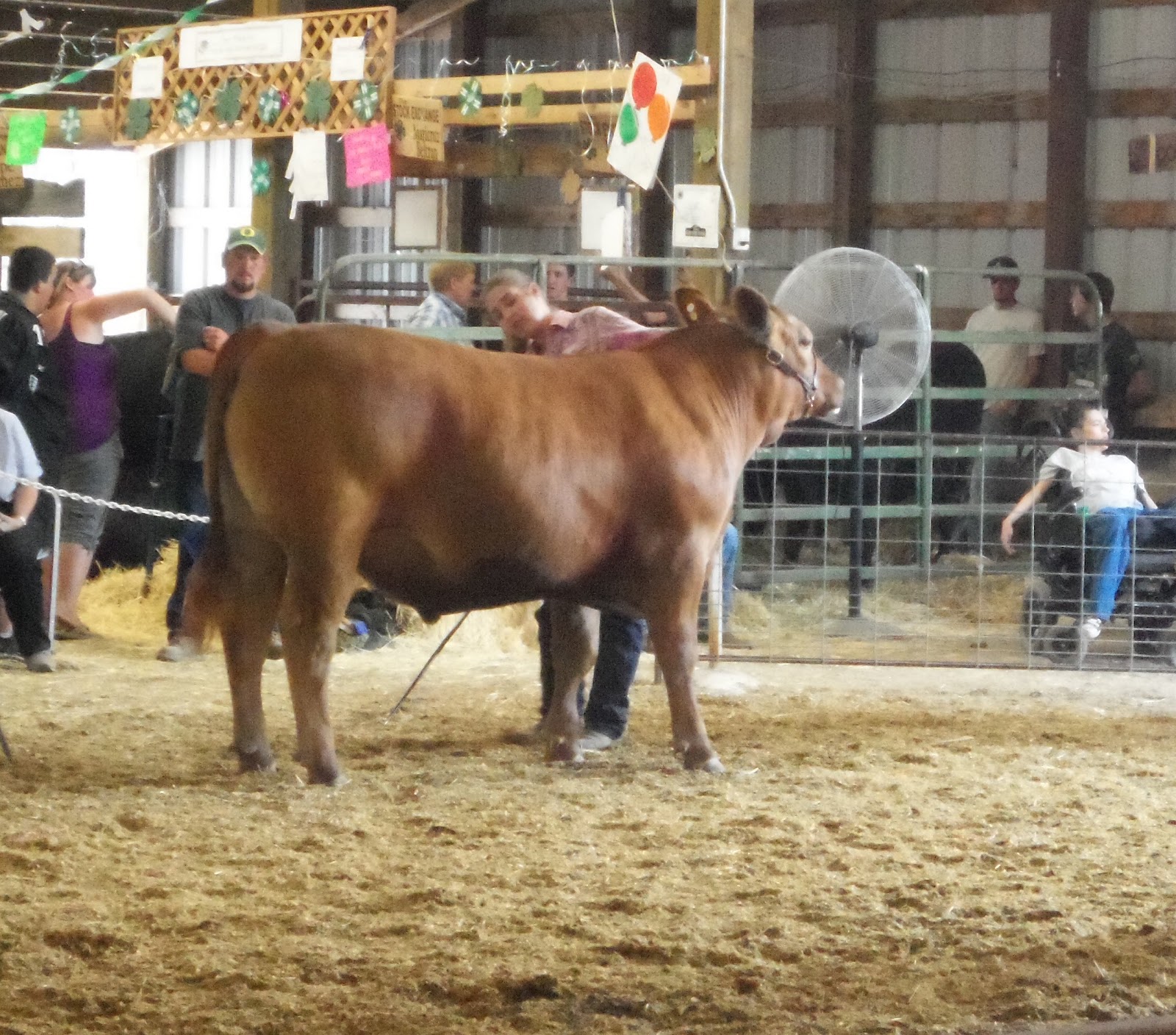
This year my steer Steve (Red Angus) won the top gaining market steer award, he gained an average of 4.07 pounds per day.


Red Angus cow, sired by MBV Cherokee 326-SOL, with her bull calf sired by BJR JR 107


In addition, I my Cow/Calf (Register Red Angus) won Grand Champion Cow/Calf pair, and her bull Calf was champion Bull.


Commercial Heifer
My commercial Red Angus heifer also made into the spotlight as Champion Commercial Heifer.


Red Angus cross
 My Steer Buck was second in his weight class as was forth over-all

In horse showmanship, I placed first in the senior class and was Grand Champion over-all in Showmanship. I also received the top over-all best Horse book plaque, as well as winning County speech, and District speech contest; and I also placed third at the State horse public speaking contest. 

I had many FCS projects and will post them later after I complete the District. I will also post how I do at District Horse.


Thursday, May 19, 2011

Beef Cattle and the Quest for Knowledge (Beef Production Medicine and Management)

I love to read;  everyone who has visited my blog knows that I truly believe that knowledge is power.

While on this quest for knowledge; last week I had a book dropped in my lap that I have not put down.

The title of this book is BEEF Production Medicine and Management; in section A; you can read about Anatomy, Biosecurity, Body condition Scoring, Nutrition, Normal ranges for temperature, heart and resporatory rates, showing junior livestock, prescription and non-prescription drug guidelines and the list goes on this is just section A.
Section B - Routine Observation and Procedures.
Section C - Vaccines and Parasite Control Products.
Section D - Tests and Diagnostics.
Section E - Flowcharts for Specific Symptoms.
Section F - Infectious Diseases, Problems and Treatment.

If you are in 4-H, FFA, or a cattle producer this is a book you should own. I have to return this one soon, but I have order my own and it will be here soon.

this book is a Animal Health Publications  you can order it on line or call 1-877-424-7838.

There is also manuals for;
Dogs and Cats
Horses
Sheep and Goats
Beef and Dairy

I think the next one that I will get will be the one for Horses. before I am done I hope to own all of them because my animal never seem to get sick on a week days.

Follow the links and check it out for yourself; KNOWLEDGE IS POWER.

Tuesday, March 29, 2011

Meet my 2011 Steers

 Well it is still raining here and it seems that the mud just keeps getting deeper. Just the other day we had wind, rain, snow, freezing rain and by the end of the day we had blue sky's and sunshine. Maybe that is the first sign of spring.

Weigh-in for my county has come and gone so here is a look at my 2011 Market Beef Project .

 My steer for 2011 are all different weights and frame styles this year; I am hoping that they don't all fall into the same weight class when our Fair rolls around.
As you can see all three are a little muddy; but they are healthy, happy, and they love to eat.
When the rain stops my steers will get their first bath, I am hoping it will be this weekend. So for now I just wait.

Just a reminder; with wet cold and changing weather that in a blink of an eye your animals can get sick so keep a close eye on them and watch for illness.

Sunday, November 28, 2010

Snow, Snow, and more Snow!

Fall this year lasted about A minute, we have lots of snow, wind, below zero weather and it is only Thanksgiving. So far we have had about one or two feet of snow; but in open acreage of flat ground and the wind blowing all the time it seems like a lot more.

I still have to go out and feed and water my steers and horses; boy it is cold! I still work with my steers at least twice a week no matter what. This is not the fun part of having 4-H steers but it is part of life if you want to be a cattle producer some day.

In weather like this I just make sure to wear the correct clothing; So bundle up and keep working.

I was told that "grand champions are made over the Thanksgiving and Christmas breaks".

REMEMBER "you got to want it to win it"

I had to dig out the water troth.

this drift went from one end of my calf pens to the other; and the water troth was under there somewhere!
I just kept digging until I found it and then had to keep digging so that my steers could get to it!
Can you see the corner of the troth, I kept working for about an hour and got it uncovered.

This could be a long Winter if I have to dig every day!
Here is hoping that the snow melts a little.

Saturday, November 20, 2010

What to Look for when Picking Your Steer

I have been getting a lot of hits looking for the qualities to look for when picking your 4-H steer. So I thought I would tell you what I look for when I pick my steers.
Muscle in the forearm, rib, loin, hip,stifle quarter and a wide base. If your young steer does not show potential in these areas when you buy him there is a very good chance he won't have it when he is finished.
Structure correctness look at the feet, straightness of the legs, and nice straight flat back with spring to the rib.depth of body, uniformity of body depth and chest width.

Now that has been said; you must have a picture of what you are looking for in your head and go into the pen of 75 to 100 head or more of cattle and pick your steer.

The way I do this is to pick 12 to 15 head that fit my list and chose from those; this only takes me about two or three hours; my cattle producer is very good to me.

I think the most important thing  to look for is a steer with as many great qualities as possible, and the most important of all is a great disposition because if you can't show them, and you can't touch them, you can't judge them.

So that perfect crazy steer that runs, jumps, puts his head in the air and paws the ground; you run don't walk away from him NO matter how perfect he may look; for he will most likely be crazy in the show ring. 

The last tip I will give is to pick what you like, and remember that every judge has their own list of qualities of what he or she looks for in a 4-H show steer and there is know way of knowing what is on their list.

One last thing the Producer knows their cattle so talk to them and always take in consideration  everything that they have to say, you are show casing their cattle and their brand is on your steer for all the world to see.

Show your steer with pride and confidence and no matter what the out come you can leave the ring knowing you did your best.
I myself have not had a Grand Champion Steer YET; but I have made it back to the championship round every year.

I do my best and  that's all I can do.

Good Luck

Wednesday, April 28, 2010

You , Your Steer, and the Grooming Chute

The weather here has had its good and bad day's. I hope you have had your steers on a regular feeding schedule, and that your steer is on full feed now and should be gaining at least 3 pounds a day. Your steer should now be touchable and leading should become easier each day hopefully you have been using the show stick each day (rain or shine);  Because the real fun is about to begin.

 The first thing I would like you to do is make sure your fitting chute is tied down. I know first hand the wreck you can have if it is not and you steer freaks out and takes off with it; your steer can become injured, and at the very least all the hard work you have done will be lost.

Now the fun part; you need to get your steer in the chute; if you have done all the ground work listed above it won't be to hard. If your steer is still a little hard to lead take your time, and add a safety rope tied to something I tie mine safety rope to the post that right next to the chute. Next take the lead rope and run it through the chute and hopefully they walk right in. If your steer does not walk in use the safety rope to get them back up to the chute and start again. Just keep working and talking to them and they will go in.


Once you have them in the chute for the first time you will want to tie their head up and just comb them; I do this with each of my steers; I want my steers to like the chute.

each one of my steers had their moment in the chute I like them to be in the chute for at least 30 minutes the first time.

I comb them talk to them and just let them know that everything is OK.

In a day or two I will but my steers back in the chute and use the blower and turn on a pair of clipper and before you know it your steers are loving the time in the chute.

 This is what works for me; when working with cattle sometimes you just play it by ear and go with what works.

Check out the Watch and Learn Youtubes for more info on clipping and other tips.

Sunday, April 11, 2010

The Show Stick

Now is the time for your steers to meet the show stick. The way that I do this is while I have them tied up and they are eating. I let them see the stick, and smell the stick. I rub their brisket first and them their belly and last I just touch their feet. Start slow and for a short time Just a few minutes; then let them finish eating. Later in the afternoon I go back out and lead them around and use the stick a little more and try to set them up, now just do this each time you work with your calves.

Your goal is to stay calm, keep your cool, and just keep working with your calves and before you know it the touching, leading and setting up will all come together. You are trying to form a bond, gain you steer trust and built your own confidence.

When this all happens you and your steer will become a team.

I know that everyone has there own way to do this. This is just what works for me.

Wednesday, April 7, 2010

Added YouTube


Check out the watch and learn page

Friday, April 2, 2010

Why Meat Goats?

My interest in Meat Goats all started when I decided to learn about how to judge the different Market animals raised and sold at fair time as part of the 4-H market animal projects.

 Then one day I started asking questions and found out that one of my Dad's friends Son is making a very good living hauling meat goats to market. So I ask myself why Meat Goats?

This what I found out:

Goat is the most highly consumed meat in the world; and more goat’s milk is consumed worldwide than cow’s milk. In the United States, meat goat production is increasing because of goats’ economic value as efficient converters of low-quality forages into quality meat, and milk,  products . There are several reasons for goats’ growing popularity in this country. A large factor is the large number of ethnic groups,  who have a preference for goat meat, milk, and cheese products.

Another factor is the determination of many Americans to be self-sufficient. Where resources are limited, a small herd of goats may be the only livestock that a small, part-time farmer can raise to achieve self-sufficiency.

As well as being one of the most widely consumed meats in the world, goat meat is also one of the healthiest meats available for consumption.  Goat meat is naturally low in fat, saturated fat and cholesterol while containing a high quantity of protein and iron.

I myself have never eaten Goats meat but I found a few different sites that might be of interest to you.

I just found this so interesting that I thought I would share it with you.

For now I will stick with my Red and Black Angus.

Monday, March 29, 2010

Swine Judging Work Shop and Judging Contest


The Swine Judging Workshop and Contest was held on  March 27 at the  Minidoka County Fairgrounds. Sign-in was at 9a.m.

Before I could even leave home I had to feed and water my steers and horses; so I had to get up really early, for it was a 1 1/2 hour drive to Minidoka. There was a team from Idaho Falls that had to get up even earlier than I did.

The workshop started at 10a.m. for me it was all new; I have never been to a swine work shop and had NO knowledge of swine, not a clue to  what they even eat.

The workshop and judging contest lasted all day. There was so much to learn. I now look at Pigs - Swine different; Their not just ham or bacon any more.

Did you know? That pigs can not sweat (perspire) to cool off. (I didn't) Because a pigs skin is so thick and they are insulated by a layer of fat, the pig must cool itself by lying in water or mud. Just a little FYI !

Back to the Workshop;
We learned how to fill out the judging card, how to take notes, and what to look for when judging swine. All of this before lunch.
After lunch we learned Terms and Transition, Muscle and Preformance, Volume and Trimness, Structure and Balance and how to format oral reasons.

--We also had guess speaker Scott Nash.


  And guest speaker Tim Hooper                                     
from the Idaho Jr. Show Pig Association


Here are a few pictures of the events of the day


Well My brain is so full of information; guess I will take a break from thinking and let it soak in for a bit.
Stay cool and keep it natural.
And don't forget to sign my guest book.


Thursday, March 25, 2010

Livestock Judging, What is it?

For the next few weeks I will be looking for different sites of interest for all 4-H projects and posting their links. This is a new Blog be the first to follow.


Livestock Judging, What is it?
 Judging activities provide youth with an opportunity to develop communication, decision making and organizational skills, and enhance their confidence and self esteem.
Judging is usually a team effort, but individuals can also participate. Three to four youth on a team will judge various classes of livestock. Typically market and breeding beef, sheep, and swine species are used in a contest. Youth will judge each class (consisting of 4 animals) and an official judge will give his placing. Youth are then scored compared to the official judge. Oral reasons may or may not be included in a contest. If a contest does have a reasons class, youth will judge the class and take notes as to why they placed the class the way they did. Youth will then get an opportunity to work and rewrite their notes into reasons. Once they are finished, then youth will present their reasons to one person and they will receive a score to be added to their overall score. New this year is the Southern III District Livestock Judging Program. There are multiple scheduled days around the district this spring and summer. The goal of the Livestock Judging Program is to help youth and adults learn; 1. What to look for when judging animals 2. How to take notes 3. Understanding terms and animal parts 4. How to format and give oral reasons.


Cindy A. Kinder Extension Educator Gooding County Idaho


Friday, March 19, 2010

Selecting 4-H Market Livestock Project Animals

INTRODUCTION — SELECTING ANIMALS FOR A "SYSTEMS APPROACH" MARKET LIVESTOCK PROGRAM
The first concept that needs to be understood is that selecting animals for a Systems Approach program is not the same as selecting a "show" animal to be groomed, molded and manipulated to fit the current fad of the show ring. With the "Systems Approach", animals are selected which, with proper management, will meet the typical standards for efficiency, profitability, and usefulness to the production, feedlot and packing industry and at the same time exhibit a high degree of acceptance by the consumer.
The Systems Approach project evaluation is based on achievement of standards for selection, management and efficient production of meat that is desirable to packer and consumer. The project evaluation card uses four categories to evaluate member achievement and success. The Lean Yield section of the card indicates the degree of success in selecting and producing a lean product profitable to the packer and desired by consumers. The Conformation/Usefulness evaluation looks individually at muscling, trimness, growth and frame and structure and balance. These factors are representative of potential for achieving a desirable yield grade, a high degree of production efficiency, a high level of consumer satisfaction and a desirable degree of longevity. The gain and quality grade section evaluates both profitability and consumer desirability. The rate of gain section recognizes successful animal management in achieving a high level of efficiency and profitability. Gain is rated higher for higher quality animals where each pound of gain is more valuable.
The primary purpose for selecting animals is to obtain an animal that when properly fed and managed will represent the best in the industry. This means that industry standards must be identified prior to selection. The following standards represent industry goals achievable by most youth livestock program participants. Judges use the "Systems Approach" evaluation card to provide an evaluation of these standards. Animal selection is guided by the same standards that are used to evaluate accomplishment.

TABLE 1. Typical minimum standards for performance and quality.

BEEF                                               
USDA yield grade 3.0 or less.
Live weight 1150 to 1300 lb.
Minimum 2.8 lb. ADG.   
Conformation Score of 22 or >.

PIGS
USDA grade of No. 1.
Muscle score of 7 or higher.
 Live weight 240 to 270 lb.
Minimum 1.85 lb. ADG.
Conformation Score of 22 or >.

LAMBS
USDA Choice Y.G. 2 or >.
Muscle score of 7 or higher.
Live weight 115 to 145 lb.
Minimum 0.75 lb. ADG.
Conformation Score of 22 or >.

 just click the link below to read it all.
this is a place to learn about selecting 4-H market livestock animals
written by: Chad C. Gibson, Gene W. Gibson, Jeff Goodwin


Wednesday, March 17, 2010

Weigh In is almost here

Weigh In of my market steers is this weekend; I can't wait to see what my steers are weighing.
After weigh in I will take my before pictures and post them so that you can see my steers.
Check back this weekend and check it out.

Just a reminder to please sign my guest book.

Sunday, November 15, 2009

The Six “C’s” for Success

I found this Artical while looking for information that might be helpful with my 4-H market animal project. So I thought I would share the Six "C" for Success with you, this artical was written by The University of Arizona.


The Six "C" For Success
1. CORRECT SELECTION
Select an animal not only with good conformation but with a personality you can work with.

2. CONSISTENCY
There are no shortcuts to success. A consistent program encompassing regular workouts will
accomplish more than a last minute flurry of activity two weeks before the show.

3. CALENDAR
Set calendar deadlines with ration changes, halter breaking, clipping and grooming, and practice
shows. Maintain a regular daily schedule of feeding, handling, and grooming your animal. Two weeks before the fair is not the time to start training your show animal.

4. COMPENSATION
Learn what your animal’s conformational strengths and weaknesses are so as to successfully
emphasize the positive and downplay faults. Similarly, if the show animal has a personality
flaw that will make showing difficult, plan ahead and compensate for this in the show ring.

5. CONFIDENCE
Show with confidence. Adequate preparation will allow you to show with a smile on your face. Be thoroughly familiar with rations, average daily gain, current weight, purchase weight, age, and breed of animal so you can answer questions from the judge. It is also important to be able to identify the different parts of the animal and the associated retail and whole sale cuts. You can help "psych" yourself up by rehearsing the show in your mind with good and bad things that could happen and how you would handle them. Performing in a practice show with members of your club or family acting, as a judge and announcer and ring steward is helpful.

6. CHARACTER
Demonstrate impeccable ethics in the preparation preceding the show and during the show itself. Be courteous to all other exhibitors, parents and leaders. The livestock show is the culmination
of the project year for many livestock participants and the community. Youth livestock exhibitors represent the livestock industry at fairs and shows to the public. A little courtesy (as well as a lot of honesty) goes a long way in relations with the public.

This is a great artical worth reading. check it out for yourself.just click the blue
The University of Arizona link.


Saturday, April 11, 2009

Valley Country Store 4-H and FFA Night.


Valley Country Store In Jerome;
Held a 4-H and FFA Night on April 9, 2009 everyone had free pizza and soft drinks before the meeting.
There were two guest speakers; the speakers covered the feeding, and care, healthy environment, safety and pen size for Sheep, Pigs and Steers.

The Speakers covered the six classes of nutrients in feeds:
Water is used to carry nutrients to the body.
Carbohydrates like sugars, starches, and cellulose provide the largest amount of energy.
Fats are concentrated energy.
Protein is used for making and repairing muscle.
Vitamins are needed in very small amounts to assist in many body functions.
Minerals such as calcium and phosphorus are important for bone development. Other minerals help many of the body functions.

The speakers also talked about how important it is to keep the pens clean; they also talked about how Exercise should be done in the morning or evening in the summer to prevent overheating.

There was a lot of other stuff covered at this meeting; I had a great time learned a lot.

If you need help with care and feeding don’t be afraid to go in to the Jerome Country Store. The staff is very friendly. Trish and Debbie are real cool!

Saturday, March 21, 2009

March 21, 2009 - Steer Weigh In


Today is the beginning of my 4-H Market Beef Project. This day started early we had to load my steers and take them to be weighted in and tagged. The week before weigh in I started giving my steers grain so that when weigh in was done my steers were ready to start the 149 days to the finished Market and the joy of showing my steers at the Fair.

Forest weighted - 745 pounds
Lt. Dan weighted - 765 pounds
Bubba weighted - 785 pounds

I have set there feeding schedule and I will talk, comb, practice and exercise them on a regular basis; this is the time for me and my steers to bond.
The weather here went from very cold to warn in just a few weeks, my steers are already loosing their winter coats soon they will be slick and shiny; their winter coats will come off even faster with daily brushing, combing, and bathing. I must tell you that having a steer project is not always just doing the fun stuff; you have to clean their pins, and watch to make sure that they stay healthy and if they get sick you will have to call the veterinarian.

Saturday, March 14, 2009

Fair Time 2008


After months of hard work; it is finely fair time and the fun part starts. You get to see if all your hard work pay off.
You need to keep a few things in mind: When going into the show ring the judge is not only looking at your steer He or She is also watching you. This is also the time when prospective buyer are watching and looking. You will want to look good; make sure you cloths are clean and pressed, and your hair is neat and clean. You what to look like a winner, the all American boy or girl showing the next Grand Champion.

Tuesday, March 10, 2009

From start to finish 2008

Training a steer to show is not an easy thing to do it takes a lot of time.
One of the first thing you want to do; is break you steer to touch. The way I do this is to use a rake and rub the steers back, brisket, and legs. You will want to do this every time you go out and feed.
The next thing is to get the halter with a long lead rope on each of your steers, Leave it on them so that they are easy to catch, You will want to check your steers twice a day to make sure that the halter is on and that the steers are alright.

Friday, March 6, 2009

from start to finish 4-h market beef Project ( Red Angus ) 2008


To break a steer for Show takes a lot of time; you must be calm, and cool when working with them.
These are not pets, These Steers are raised as a of the 4-H market Beef Project. Along with showing them in the Show Ring. In the program you must keep health records, activity records, the 4-H member must do all the care, feeding and cleaning of the pen's themselves. This is a very demanding project.