I love to read; everyone who has visited my blog knows that I truly believe that knowledge is power.
While on this quest for knowledge; last week I had a book dropped in my lap that I have not put down.
The title of this book is BEEF Production Medicine and Management; in section A; you can read about Anatomy, Biosecurity, Body condition Scoring, Nutrition, Normal ranges for temperature, heart and resporatory rates, showing junior livestock, prescription and non-prescription drug guidelines and the list goes on this is just section A.
Section B - Routine Observation and Procedures.
Section C - Vaccines and Parasite Control Products.
Section D - Tests and Diagnostics.
Section E - Flowcharts for Specific Symptoms.
Section F - Infectious Diseases, Problems and Treatment.
If you are in 4-H, FFA, or a cattle producer this is a book you should own. I have to return this one soon, but I have order my own and it will be here soon.
this book is a Animal Health Publications you can order it on line or call 1-877-424-7838.
There is also manuals for;
Dogs and Cats
Horses
Sheep and Goats
Beef and Dairy
I think the next one that I will get will be the one for Horses. before I am done I hope to own all of them because my animal never seem to get sick on a week days.
Follow the links and check it out for yourself; KNOWLEDGE IS POWER.
Life On The Farm As The Years Fly Bye


4H My Journey
2011-2012 Western National Roundup
Showing posts with label health record. Show all posts
Showing posts with label health record. Show all posts
Thursday, May 19, 2011
Tuesday, March 29, 2011
Meet my 2011 Steers
Well it is still raining here and it seems that the mud just keeps getting deeper. Just the other day we had wind, rain, snow, freezing rain and by the end of the day we had blue sky's and sunshine. Maybe that is the first sign of spring.
Weigh-in for my county has come and gone so here is a look at my 2011 Market Beef Project .
My steer for 2011 are all different weights and frame styles this year; I am hoping that they don't all fall into the same weight class when our Fair rolls around.


 As you can see all three are a little muddy; but they are healthy, happy, and they love to eat.
When the rain stops my steers will get their first bath, I am hoping it will be this weekend. So for now I just wait.
Just a reminder; with wet cold and changing weather that in a blink of an eye your animals can get sick so keep a close eye on them and watch for illness.
Weigh-in for my county has come and gone so here is a look at my 2011 Market Beef Project .
My steer for 2011 are all different weights and frame styles this year; I am hoping that they don't all fall into the same weight class when our Fair rolls around.


When the rain stops my steers will get their first bath, I am hoping it will be this weekend. So for now I just wait.
Just a reminder; with wet cold and changing weather that in a blink of an eye your animals can get sick so keep a close eye on them and watch for illness.

Monday, December 13, 2010
Oh Joy MUD !
How is the weather where you live? The weather here has warmed up and all the snow has turned to mud!
If you have a lot of mud you may want to keep an eye on your steers to make sure there hoofs are in good shape. I do checks everyday when the weather can't seem to make up it's mind.
I have also started some of my FCS projects and hope to have most of them done by spring so that I will have more time for my Market animal projects.
Well my break is over back to school!
If you have a lot of mud you may want to keep an eye on your steers to make sure there hoofs are in good shape. I do checks everyday when the weather can't seem to make up it's mind.
I have also started some of my FCS projects and hope to have most of them done by spring so that I will have more time for my Market animal projects.
Well my break is over back to school!
Thursday, September 16, 2010
Grading My Market Project Steers ( know what you are eating )
Today I went to the Bates Custom Butchers and graded my two remaining 4-H steers.

 Cindy Kinder the Extension Educator for Gooding County was my teacher.
To grade my beef we measured the size of the rib eye, back fat, and figure the kph fat, and you must have the carcass weight.
These two beef graded prime minus and choice plus. my third beef graded prime plus.
Grades are based on the amount of marbling in the meat and the age of the animal. Marbling is the flecks and streaks of white fat you find distributed throughout the meat. In general, the higher the degree of marbling, the more tender, juicy, and flavorable the meat will be. Higher grade meats come at a higher cost.
Beef is best in flavor and texture when cattle are between 18 and 24 months old, so the grading favors younger animals.
Meat graders assign a yield grade to a carcass by evaluating:
There are eight distinct grades of beef recognized by the USDA.


Just over half of the beef graded each your earns a grade of Choice.

USDA. In order of descending quality they are:
http://meat.tamu.edu/beefgrading.html
http://www.bbqreport.com/archives/barbecue/2006/03/02/understanding-the-usda-beef-grading-system/
and from
Cindy Kinder Extension Educator for Gooding County
for more information click the links above.
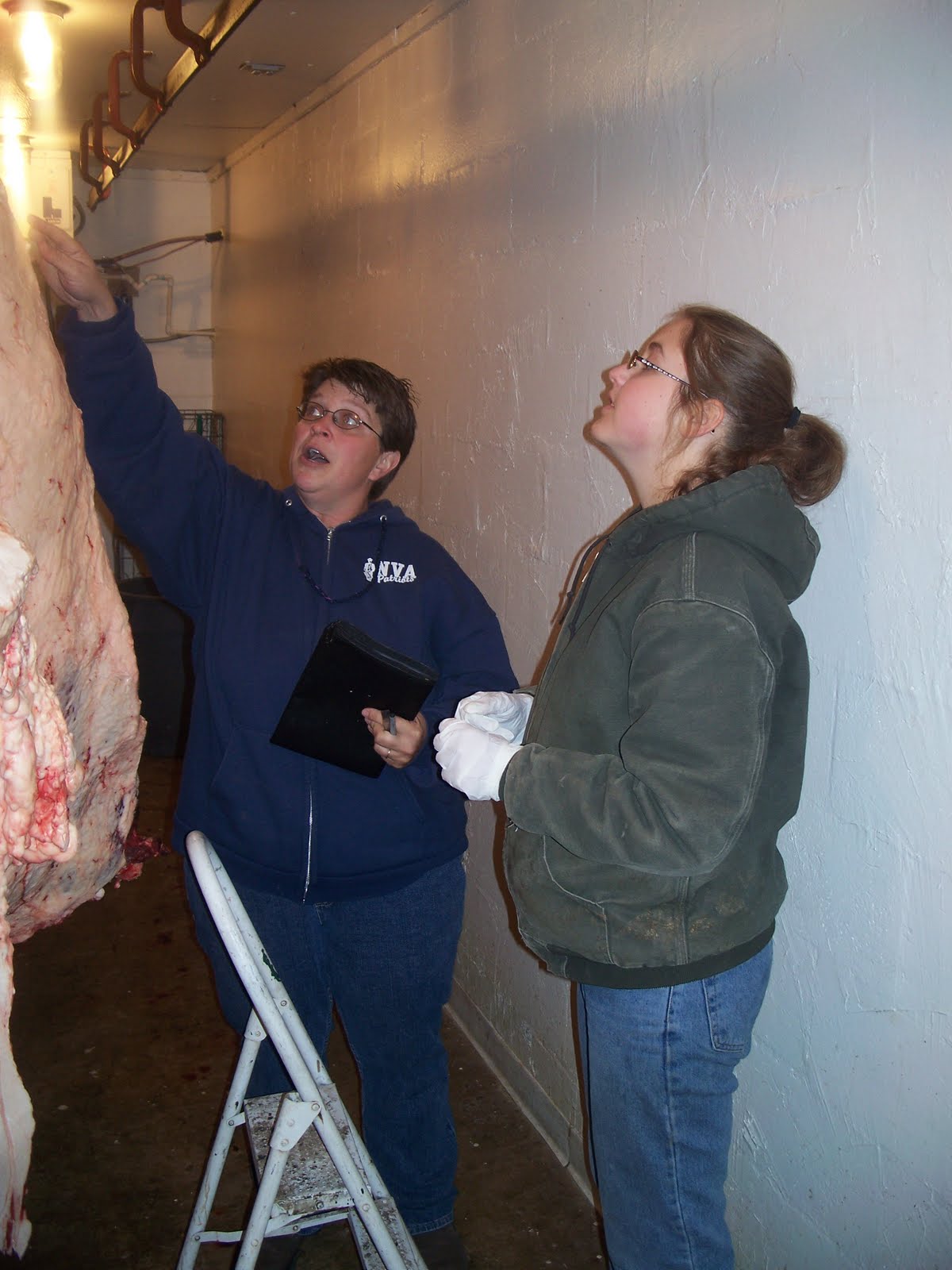
 Cindy Kinder the Extension Educator for Gooding County was my teacher.
To grade my beef we measured the size of the rib eye, back fat, and figure the kph fat, and you must have the carcass weight.
These two beef graded prime minus and choice plus. my third beef graded prime plus.
Grades are based on the amount of marbling in the meat and the age of the animal. Marbling is the flecks and streaks of white fat you find distributed throughout the meat. In general, the higher the degree of marbling, the more tender, juicy, and flavorable the meat will be. Higher grade meats come at a higher cost.
Beef is best in flavor and texture when cattle are between 18 and 24 months old, so the grading favors younger animals.
Meat graders assign a yield grade to a carcass by evaluating:
- the amount of external fat;
- the hot carcass weight;
- the amount of kidney, pelvic, and heart fat; and
- the area of the ribeye muscle.
There are eight distinct grades of beef recognized by the USDA.

USDA Prime Beef
- is the ultimate in tenderness, juiciness, and flavor.

USDA Choice Beef
Choice grade beef has less marbling than Prime, but is still of very high quality. This is the most popular grade of beef because it contains sufficient marbling for taste.Just over half of the beef graded each your earns a grade of Choice.

USDA Select beef
This is generally a lower priced grade of beef with less marbling than Choice. Select cuts of beef may vary in tenderness and juiciness.USDA. In order of descending quality they are:
- Prime
- Choice
- Select
- Standard
- Commercial
- Utility
- Cutter
- Canner
http://meat.tamu.edu/beefgrading.html
http://www.bbqreport.com/archives/barbecue/2006/03/02/understanding-the-usda-beef-grading-system/
and from
Cindy Kinder Extension Educator for Gooding County
for more information click the links above.
Tuesday, March 30, 2010
Beef Quality Assurance
If you have a market beef project these are must reads, just follow the links to read all the information about Beef Quality Assurance.
Beef Quality Assurance is a national program that provides guidelines for beef cattle production. The program raises consumer confidence through offering proper management techniques and a commitment to quality within every segment of the beef industry.
“BQA is a process of figuring out what could go wrong, planning to avoid it – then validating and documenting what you have done. BQA is just part of good business,” explains Dee Griffin, DVM, associate professor at the University of Nebraska
Youth BQA objective
Youth BQA assist youth in understanding their role as producers in the food supply chain and their responsibility to produce a safe food product while caring for animals is an ethical manner.
Beef Quality Assurance is a national program that provides guidelines for beef cattle production. The program raises consumer confidence through offering proper management techniques and a commitment to quality within every segment of the beef industry.
“BQA is a process of figuring out what could go wrong, planning to avoid it – then validating and documenting what you have done. BQA is just part of good business,” explains Dee Griffin, DVM, associate professor at the University of Nebraska
Youth BQA objective
Youth BQA assist youth in understanding their role as producers in the food supply chain and their responsibility to produce a safe food product while caring for animals is an ethical manner.
Saturday, March 20, 2010
My 2010 4-H Steers


This is Pepper he weighed in at 878 pounds.
Black Angus

And this is George he weighed in at 868 pounds. Red Angus
All my steers lead and behaved very well the weigh-in process went very smooth; but they were glad to get home.
Now it is time to set the feeding, exercise, and training schedules.
Let the fun begin!!
Friday, March 19, 2010
Selecting 4-H Market Livestock Project Animals
INTRODUCTION — SELECTING ANIMALS FOR A "SYSTEMS APPROACH" MARKET LIVESTOCK PROGRAM
The first concept that needs to be understood is that selecting animals for a Systems Approach program is not the same as selecting a "show" animal to be groomed, molded and manipulated to fit the current fad of the show ring. With the "Systems Approach", animals are selected which, with proper management, will meet the typical standards for efficiency, profitability, and usefulness to the production, feedlot and packing industry and at the same time exhibit a high degree of acceptance by the consumer.
The Systems Approach project evaluation is based on achievement of standards for selection, management and efficient production of meat that is desirable to packer and consumer. The project evaluation card uses four categories to evaluate member achievement and success. The Lean Yield section of the card indicates the degree of success in selecting and producing a lean product profitable to the packer and desired by consumers. The Conformation/Usefulness evaluation looks individually at muscling, trimness, growth and frame and structure and balance. These factors are representative of potential for achieving a desirable yield grade, a high degree of production efficiency, a high level of consumer satisfaction and a desirable degree of longevity. The gain and quality grade section evaluates both profitability and consumer desirability. The rate of gain section recognizes successful animal management in achieving a high level of efficiency and profitability. Gain is rated higher for higher quality animals where each pound of gain is more valuable.
The primary purpose for selecting animals is to obtain an animal that when properly fed and managed will represent the best in the industry. This means that industry standards must be identified prior to selection. The following standards represent industry goals achievable by most youth livestock program participants. Judges use the "Systems Approach" evaluation card to provide an evaluation of these standards. Animal selection is guided by the same standards that are used to evaluate accomplishment.
TABLE 1. Typical minimum standards for performance and quality.
BEEF
USDA yield grade 3.0 or less.
Live weight 1150 to 1300 lb.
Minimum 2.8 lb. ADG.
Conformation Score of 22 or >.
PIGS
USDA grade of No. 1.
Muscle score of 7 or higher.
Live weight 240 to 270 lb.
Minimum 1.85 lb. ADG.
Conformation Score of 22 or >.
LAMBS
USDA Choice Y.G. 2 or >.
Muscle score of 7 or higher.
Live weight 115 to 145 lb.
Minimum 0.75 lb. ADG.
Conformation Score of 22 or >.
just click the link below to read it all.
this is a place to learn about selecting 4-H market livestock animals
written by: Chad C. Gibson, Gene W. Gibson, Jeff Goodwin
The first concept that needs to be understood is that selecting animals for a Systems Approach program is not the same as selecting a "show" animal to be groomed, molded and manipulated to fit the current fad of the show ring. With the "Systems Approach", animals are selected which, with proper management, will meet the typical standards for efficiency, profitability, and usefulness to the production, feedlot and packing industry and at the same time exhibit a high degree of acceptance by the consumer.
The Systems Approach project evaluation is based on achievement of standards for selection, management and efficient production of meat that is desirable to packer and consumer. The project evaluation card uses four categories to evaluate member achievement and success. The Lean Yield section of the card indicates the degree of success in selecting and producing a lean product profitable to the packer and desired by consumers. The Conformation/Usefulness evaluation looks individually at muscling, trimness, growth and frame and structure and balance. These factors are representative of potential for achieving a desirable yield grade, a high degree of production efficiency, a high level of consumer satisfaction and a desirable degree of longevity. The gain and quality grade section evaluates both profitability and consumer desirability. The rate of gain section recognizes successful animal management in achieving a high level of efficiency and profitability. Gain is rated higher for higher quality animals where each pound of gain is more valuable.
The primary purpose for selecting animals is to obtain an animal that when properly fed and managed will represent the best in the industry. This means that industry standards must be identified prior to selection. The following standards represent industry goals achievable by most youth livestock program participants. Judges use the "Systems Approach" evaluation card to provide an evaluation of these standards. Animal selection is guided by the same standards that are used to evaluate accomplishment.
TABLE 1. Typical minimum standards for performance and quality.
BEEF
USDA yield grade 3.0 or less.
Live weight 1150 to 1300 lb.
Minimum 2.8 lb. ADG.
Conformation Score of 22 or >.
PIGS
USDA grade of No. 1.
Muscle score of 7 or higher.
Live weight 240 to 270 lb.
Minimum 1.85 lb. ADG.
Conformation Score of 22 or >.
LAMBS
USDA Choice Y.G. 2 or >.
Muscle score of 7 or higher.
Live weight 115 to 145 lb.
Minimum 0.75 lb. ADG.
Conformation Score of 22 or >.
just click the link below to read it all.
this is a place to learn about selecting 4-H market livestock animals
written by: Chad C. Gibson, Gene W. Gibson, Jeff Goodwin
Wednesday, March 17, 2010
Weigh In is almost here
Weigh In of my market steers is this weekend; I can't wait to see what my steers are weighing.
After weigh in I will take my before pictures and post them so that you can see my steers.
Check back this weekend and check it out.
Just a reminder to please sign my guest book.
After weigh in I will take my before pictures and post them so that you can see my steers.
Check back this weekend and check it out.
Just a reminder to please sign my guest book.
Wednesday, October 21, 2009
Getting Ready for My 2010 4-H Market Beef Project
This is the time of the year when I start to get ready for my new Steers. Before I can bring them home I must clean and repair the calf pens. When Cleaning my pens I remove all old poop clear down to the dirt; I like my steer to start the winter with a very clean pen.
Last year was really cold and it snowed a lot. I was not quite ready for all that snow and had my hay stacked a long ways away from my calf pens. This year I have my hay right next to the pens to make it easier for me if it snows a lot this year. I also helped my Dad put tarps on all our hay to keep it dry so that we do not loose a lot of hay to mold. I also helped my dad redo my calf pens and make them a little larger to give my steers more room this winter.
Next I check all the water hoses and place straw around our frost free water facet so if we have a lot of wind it won't freeze it up; this is just to be on the safe side.
I have cleaned and repaired pens, good dry hay, I have winterized our frost free water facet and check all my hoses.

I also make sure that I have a bloat kit on hand, and set out mineral blocks.
Our horses are not a 4-H project; but I also helped clean and ready them for winter. We stocked up on grain and gave them a mineral salt block.
Well I think I am ready to go and pick my steers. I am sure my Dad will find something I forgot, just because that what Dad's do.
I have already talked to the cattle producer that I get my steers from; Mr. Vos from the Clover Creek Ranch will call me when the calves are ready.
Now the hard part; I wait for the call.
Last year was really cold and it snowed a lot. I was not quite ready for all that snow and had my hay stacked a long ways away from my calf pens. This year I have my hay right next to the pens to make it easier for me if it snows a lot this year. I also helped my Dad put tarps on all our hay to keep it dry so that we do not loose a lot of hay to mold. I also helped my dad redo my calf pens and make them a little larger to give my steers more room this winter.
Next I check all the water hoses and place straw around our frost free water facet so if we have a lot of wind it won't freeze it up; this is just to be on the safe side.
I have cleaned and repaired pens, good dry hay, I have winterized our frost free water facet and check all my hoses.

Our horses are not a 4-H project; but I also helped clean and ready them for winter. We stocked up on grain and gave them a mineral salt block.
Well I think I am ready to go and pick my steers. I am sure my Dad will find something I forgot, just because that what Dad's do.
I have already talked to the cattle producer that I get my steers from; Mr. Vos from the Clover Creek Ranch will call me when the calves are ready.
Now the hard part; I wait for the call.
Saturday, March 21, 2009
March 21, 2009 - Steer Weigh In


Today is the beginning of my 4-H Market Beef Project. This day started early we had to load my steers and take them to be weighted in and tagged. The week before weigh in I started giving my steers grain so that when weigh in was done my steers were ready to start the 149 days to the finished Market and the joy of showing my steers at the Fair.
Forest weighted - 745 pounds
Lt. Dan weighted - 765 pounds
Bubba weighted - 785 pounds
I have set there feeding schedule and I will talk, comb, practice and exercise them on a regular basis; this is the time for me and my steers to bond.
The weather here went from very cold to warn in just a few weeks, my steers are already loosing their winter coats soon they will be slick and shiny; their winter coats will come off even faster with daily brushing, combing, and bathing. I must tell you that having a steer project is not always just doing the fun stuff; you have to clean their pins, and watch to make sure that they stay healthy and if they get sick you will have to call the veterinarian.
Saturday, March 14, 2009
Fair Time 2008


After months of hard work; it is finely fair time and the fun part starts. You get to see if all your hard work pay off.
You need to keep a few things in mind: When going into the show ring the judge is not only looking at your steer He or She is also watching you. This is also the time when prospective buyer are watching and looking. You will want to look good; make sure you cloths are clean and pressed, and your hair is neat and clean. You what to look like a winner, the all American boy or girl showing the next Grand Champion.
Our First Meeting 2009
The meeting was called to order, pledges were said.
Old business - Hunter received his Clover Bud project awards.
New Business - All member renewed memberships, New Projects for 2009 were listed, and we talk about what we would like to do for Community Services project, and what we would like to learn this year.
All weight in Dates were given along with the dead line for each.
The meeting was adjourned and we all had a snack.
It was nice to see all my 4-H friends.
Old business - Hunter received his Clover Bud project awards.
New Business - All member renewed memberships, New Projects for 2009 were listed, and we talk about what we would like to do for Community Services project, and what we would like to learn this year.
All weight in Dates were given along with the dead line for each.
The meeting was adjourned and we all had a snack.
It was nice to see all my 4-H friends.
Friday, March 6, 2009
from start to finish 4-h market beef Project ( Red Angus ) 2008


To break a steer for Show takes a lot of time; you must be calm, and cool when working with them.
These are not pets, These Steers are raised as a of the 4-H market Beef Project. Along with showing them in the Show Ring. In the program you must keep health records, activity records, the 4-H member must do all the care, feeding and cleaning of the pen's themselves. This is a very demanding project.
from start to finish 4-h market beef Project ( Red Angus ) 2008


I am in 4-H; this is a picture of my steer project this is a baby steer he weights about 750 pounds. This is just one of many projects. This is Clover, I also has another steer Mikey, both steers are Red Angus.
Subscribe to:
Posts (Atom)